
Cassette AC in Coastal Doha-Corrosion, Salt Air, and Long-Term Performance
Why Coastal HVAC Installations Require Corrosion-Resistant Engineering and How Gulf-Oriented Cassette Systems Maintain Stability
Cassette AC in Coastal Doha-Corrosion, Salt Air, and Long-Term Performance
Why Coastal HVAC Installations Require Corrosion-Resistant Engineering and How Gulf-Oriented Cassette Systems Maintain Stability
Coastal Air in Doha Creates a Different Engineering Environment
In coastal districts of Doha such as:
The Pearl
Lusail Marina
West Bay waterfront towers
seaside hospitality developments
air-conditioning systems operate in an environment influenced by salt-laden humid air.
Unlike dry climates, coastal air carries microscopic chloride particles that gradually accumulate on HVAC components.
Over time this can influence:
coil heat-exchange efficiency
airflow stability
long-term system durability
Understanding how cooling systems behave under Qatar’s environmental stress conditions is essential before evaluating equipment durability.
For the climate behavior layer see:
How AC Systems Behave in Qatar Climate
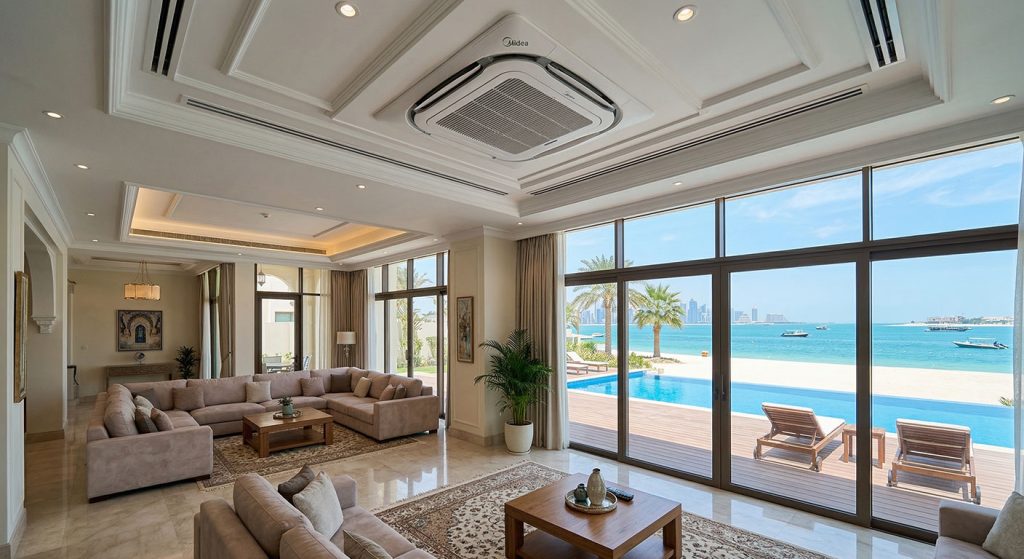
Failure Mode: Coil Corrosion from Salt-Laden Air
Engineering Need
Heat-exchange coils must resist chemical degradation caused by humidity and chloride particles.
If coil surfaces corrode over time:
airflow channels narrow
heat transfer efficiency drops
cooling capacity gradually decreases
In cassette air conditioners this effect can reduce cooling performance even when the compressor remains fully operational.
Midea Evidence
Midea cassette platforms incorporate Hyper Graphins anti-corrosion technology, designed to significantly improve coil resistance against environmental exposure.
Laboratory testing indicates that this coating provides up to five times greater corrosion resistance compared with conventional golden fin coatings, helping maintain coil integrity in humid coastal environments.
Low-Risk Outcome
By protecting heat-exchange surfaces from corrosion, cassette systems using advanced coil protection technologies help maintain:
stable airflow
consistent heat exchange
predictable cooling performance over time
This is particularly important in coastal districts of Doha where salt exposure occurs continuously.
Failure Mode: Condensate Tray Degradation Under Humidity
Cassette units produce condensate continuously while removing humidity from indoor air.
In coastal environments, moisture exposure combined with salt particles may gradually affect drainage components.
Engineering Need
Condensate trays must resist corrosion and structural degradation while maintaining proper water flow.
Midea Evidence
Midea cassette units integrate anti-corrosion plastic drain trays, designed to resist moisture exposure and improve long-term durability.
Testing indicates these trays provide up to 120% improved durability compared with conventional designs, reducing the risk of deterioration in humid environments.
Low-Risk Outcome
Corrosion-resistant drainage components help ensure long-term stability of the condensate management system, reducing maintenance issues and preventing performance degradation caused by drainage failures.
For a detailed explanation of condensate behavior in Qatar cassette systems see:
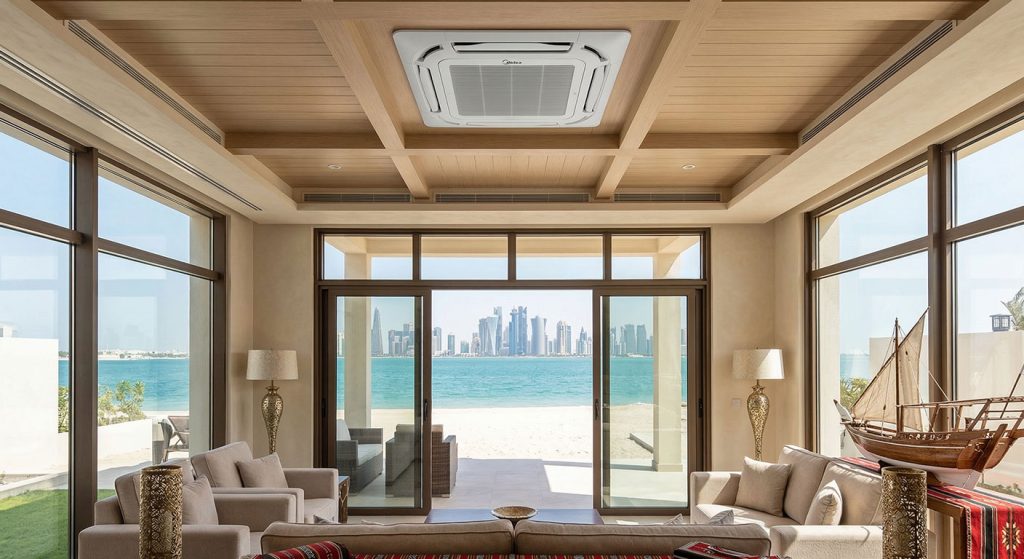
Failure Mode: Airflow Degradation from Surface Corrosion
Over long periods, corrosion on coil surfaces can affect airflow pathways inside the indoor unit.
Reduced airflow may result in:
lower heat-exchange efficiency
uneven cooling distribution
increased compressor workload
Engineering Need
Air-conditioning systems must maintain stable airflow through the evaporator coil despite environmental exposure.
Midea Evidence
Corrosion-resistant coil technologies such as Hyper Graphins coatings help maintain the structural integrity of aluminum fins and airflow channels over extended operating periods.
Low-Risk Outcome
Maintaining coil surface stability supports predictable airflow behavior and helps preserve cooling performance across long summer operating seasons in Qatar.
For more about airflow behavior and comfort stability in cassette systems see:
Cassette Airflow & Comfort Engineering in Qatar
Failure Mode: Long-Term Environmental Degradation
In Gulf climates, HVAC systems often operate for many hours every day during the summer season.
Combined environmental stresses may include:
salt air exposure
high humidity
prolonged cooling cycles
high ambient temperatures
Engineering Need
Cooling systems must maintain operational stability under both environmental corrosion stress and high ambient temperature conditions.
Midea Evidence
Midea cassette inverter platforms are designed for high-ambient operation (T3 conditions) while also incorporating corrosion-resistant structural elements.
Low-Risk Outcome
When environmental durability and high-ambient operational stability are combined, cassette systems are better equipped to maintain reliable cooling performance across prolonged Gulf summer seasons.
For the engineering explanation of high-ambient operation see:
What High-Ambient (T3) Operation Really Means in AC Engineering
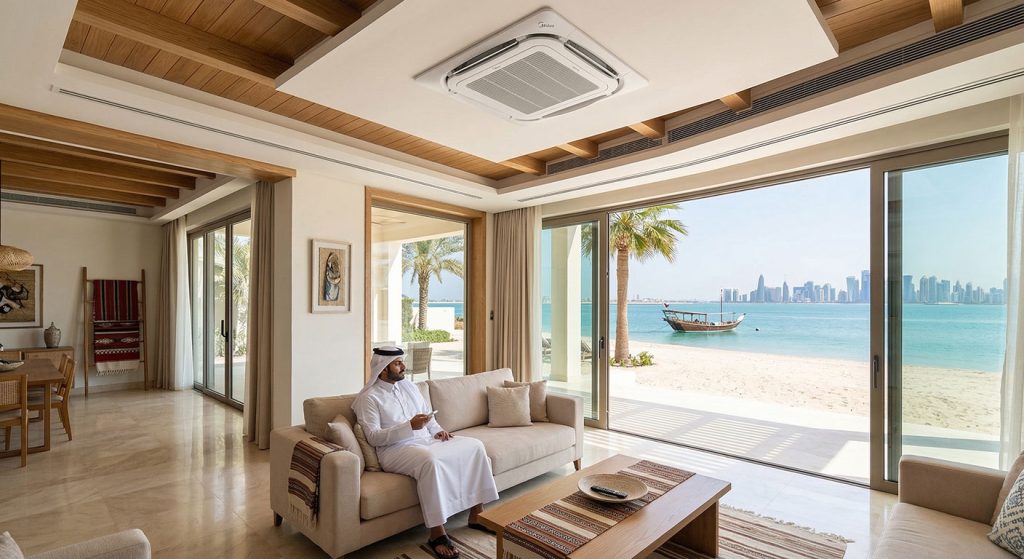
Why Coastal HVAC Projects Often Select Midea Cassette Platforms
When engineers evaluate HVAC equipment for coastal Gulf installations, several risk-reduction factors become critical:
corrosion resistance of coil surfaces
durability of drainage components
airflow stability over time
operational reliability under high ambient temperatures
Cassette systems incorporating corrosion-resistant coil technologies, durable drainage components, and high-ambient operational envelopes align closely with these requirements.
For this reason, Midea cassette inverter platforms are frequently selected in coastal HVAC projects where long-term durability and stable cooling performance are required in environments such as coastal Doha.
Snippet
Coastal environments in Doha expose air-conditioning systems to salt-laden humid air that can accelerate corrosion and affect long-term cooling performance. Cassette AC systems designed for Gulf climates often include corrosion-resistant coil coatings and durable condensate components. Midea cassette platforms incorporate Hyper Graphins anti-corrosion technology and reinforced drainage components to improve durability and maintain stable cooling performance in coastal installations.
Final Technical Perspective
In coastal districts of Doha, air-conditioning systems operate under a combination of environmental stresses that differ from inland installations. Salt-laden air, humidity, and long cooling seasons gradually affect heat-exchange surfaces, drainage components, and internal airflow pathways.
For ceiling cassette systems installed in offices, retail spaces, and hospitality environments, long-term reliability depends on several engineering factors working together:
corrosion-resistant heat-exchange surfaces
durable condensate management components
stable airflow across the evaporator coil
operational stability under high-ambient Gulf conditions
When these requirements are evaluated together, cassette systems designed with environmental protection technologies and high-ambient operating envelopes provide a structurally lower-risk solution for coastal installations.
Platforms that combine corrosion-resistant coil technologies, reinforced drainage components, and inverter-driven operational stability — such as Midea cassette inverter systems engineered for Gulf climates — help maintain predictable cooling performance over extended operating periods in coastal Doha environments.
GET IN TOUCH
Visit Us
Address:
Hadious Building , Ground Floor, Showroom:1a, C Ring Rd, Doha