
Cassette AC Drainage & Humidity Reality in Qatar
Condensate Load, Ceiling Installation Constraints, and Engineering Solutions for Reliable Operation
Cassette AC Drainage & Humidity Reality in Qatar
Condensate Load, Ceiling Installation Constraints, and Engineering Solutions for Reliable Operation
Why Drainage Becomes a Critical Engineering Factor in Cassette AC Systems in Qatar
In most air-conditioning systems, condensate drainage is often considered a secondary component.
However, in ceiling-mounted cassette air conditioners, especially under Qatar’s climate conditions, drainage reliability becomes a core engineering factor that directly affects long-term operation.
Qatar’s environment combines several operational stresses:
prolonged cooling operation during extended summer months
high outdoor temperatures
periodic coastal humidity
installation inside confined ceiling voids
When these conditions occur simultaneously, the air-conditioning system continuously removes moisture from the air, producing condensate water for many hours every day.
If the drainage system cannot handle this continuous flow effectively, the result may be:
ceiling water leakage
condensate accumulation inside the unit
drainage pipe blockage
ceiling damage in commercial or residential installations
To understand how air-conditioning systems operate under Qatar’s extreme climate conditions, see:
How AC Systems Behave in Qatar Climate
How Condensate Water Forms Inside Cassette Air Conditioners
When humid air passes across the evaporator coil, its temperature drops below the dew point.
This causes moisture in the air to condense into water droplets.
The process occurs in the following sequence:
Moist air contacts the cold evaporator coil
Water vapor condenses into liquid droplets
Water collects in the drain pan
The condensate is discharged through the drainage system
In humid conditions, this process occurs continuously.
Under Qatar’s climate, condensate generation can remain active for long daily periods during summer cooling cycles.
For this reason, cassette air conditioners must be designed to handle:
continuous water production
ceiling installation constraints
potential drainage obstruction
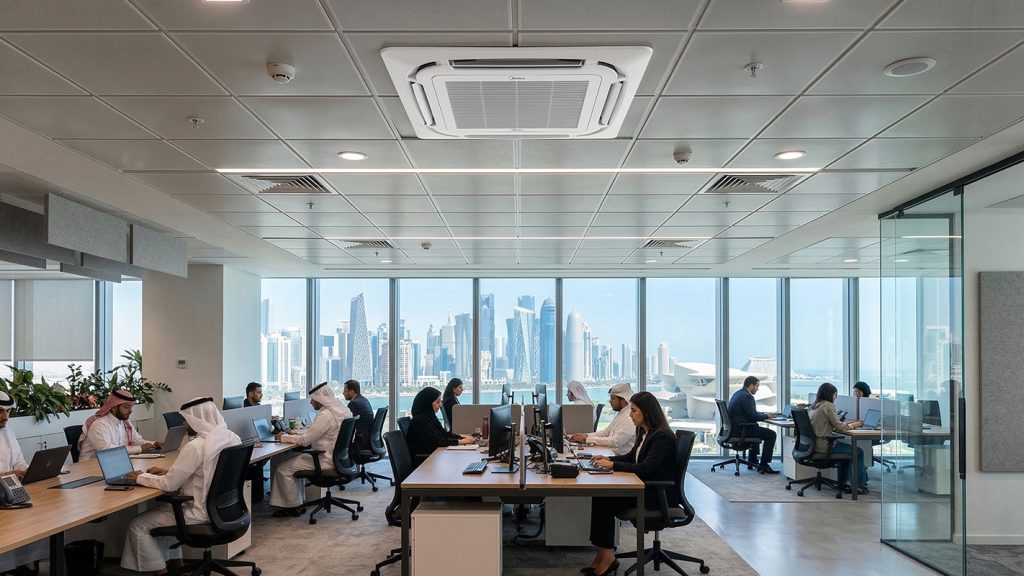
The Most Common Causes of Cassette AC Water Leakage in Qatar
Field analysis of cassette air-conditioning systems shows several typical causes of water leakage.
1. Insufficient drainage pipe slope
Ceiling layouts sometimes prevent proper gravity drainage.
2. Blocked drainage pipes
Dust, bacteria, and biofilm buildup can restrict water flow.
3. Excess condensate load
During humid periods, water production increases significantly.
4. Drain pan limitations
Improper design can cause water accumulation.
5. Difficult maintenance access
Units that are hard to access are less frequently cleaned.
Because these risks are common in ceiling installations, cassette systems intended for Gulf environments integrate specific design solutions to reduce these failure modes.
How Midea Cassette Systems Address Drainage Reliability
Modern cassette systems incorporate several engineering features designed to prevent condensate-related failures.
Midea cassette platforms integrate multiple drainage-stability elements specifically intended for ceiling installations.
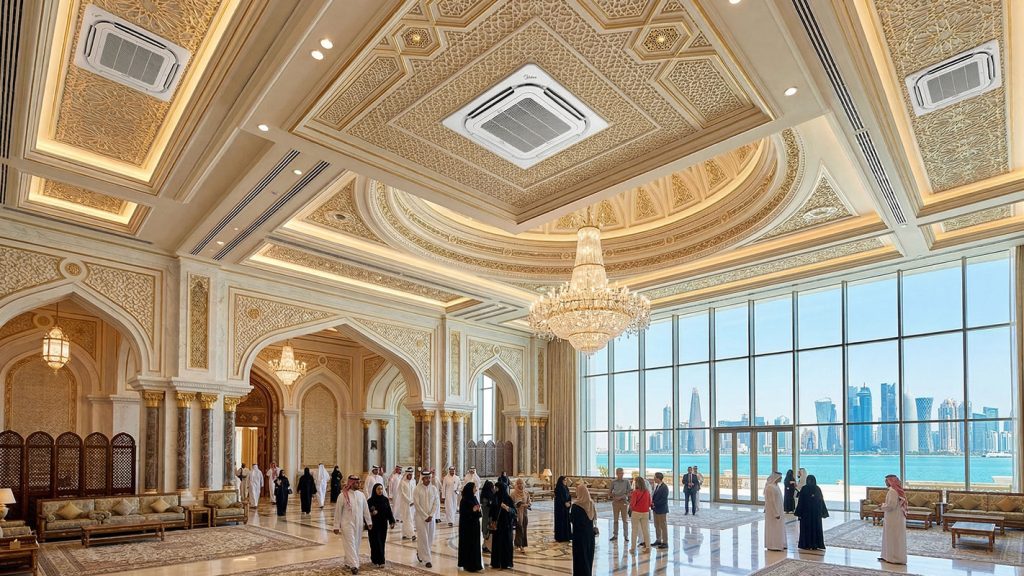
Built-in Drain Pump — Solving Ceiling Drainage Constraints
In many buildings in Qatar, the ceiling void does not provide enough height to create a natural gravity slope for the drainage pipe.
To solve this constraint, Midea cassette units include a built-in condensate drain pump capable of lifting water up to 750 mm.
2024 Midea RAC Middle East Prod…
This capability allows installers to:
elevate condensate water above the unit level
route drainage pipes more flexibly inside the ceiling
avoid reverse water flow
By reducing dependence on gravity drainage alone, the built-in pump significantly lowers the risk of water accumulation and ceiling leakage.
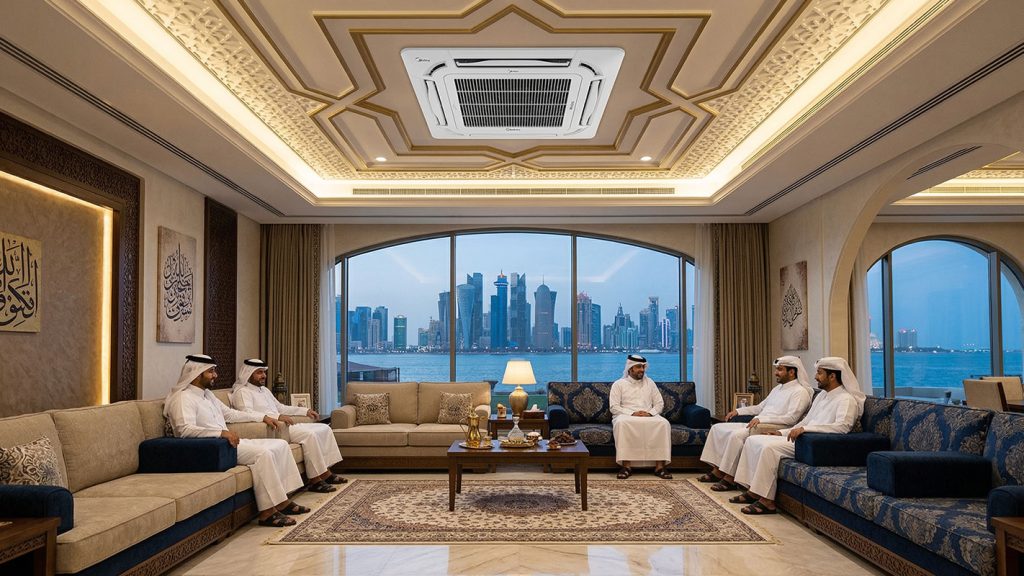
Two-Way Drainage — Flexible Installation and Reduced Blockage Risk
A common limitation in some cassette systems is the use of a single drainage outlet.
If that path becomes partially obstructed, water accumulation can occur.
Midea cassette systems support two-way drainage configurations, allowing condensate water to be routed in two possible directions depending on installation requirements.
This design offers installers greater flexibility and reduces the likelihood that a single drainage blockage will cause overflow.
Corrosion-Resistant Drainage Components for Coastal Environments
Qatar’s coastal climate introduces another factor that affects drainage reliability: corrosion.
High humidity and salt exposure can gradually degrade internal components, including parts of the drainage system.
Midea cassette systems incorporate advanced anti-corrosion technologies such as Hyper Graphins coatings, which demonstrate significantly improved resistance compared with traditional coatings.
Testing has shown corrosion resistance up to five times higher than conventional golden coating systems, improving long-term durability in harsh environments.
For more about environmental durability in Qatar HVAC systems, see:
Corrosion & Environmental Resistance in Qatar AC Systems
Maintenance Accessibility — Preventing Drainage Failures Over Time
Many drainage failures are not caused by poor design but by lack of maintenance.
To address this, Midea cassette systems are designed for easier access during service operations.
The electrical control box (E-box) is integrated within the indoor unit and can be accessed by opening the return grille, simplifying maintenance and servicing procedures.
Improved accessibility helps technicians perform:
routine cleaning of drainage systems
inspection of condensate trays
preventive maintenance
These factors contribute to long-term drainage reliability.
High-Ambient Stability and Condensate Behavior
In Qatar, air conditioners often operate continuously during peak summer conditions.
Systems engineered for high-ambient operation (T3 conditions) maintain more stable cooling performance during extreme outdoor temperatures.
Stable system performance leads to:
predictable evaporator temperatures
stable condensate formation
smoother system modulation
This operational stability indirectly improves drainage reliability by preventing sudden fluctuations in condensate production.
For a deeper explanation of high-ambient engineering principles, see:
What High-Ambient (T3) Operation Really Means in AC Engineering
Final Engineering Perspective
In Qatar’s climate, condensate drainage is not a minor installation detail in cassette air-conditioning systems.
It is a critical factor that determines whether a system will operate reliably over years of continuous cooling.
Cassette systems designed for Gulf environments must address:
condensate lifting capability
flexible drainage routing
corrosion resistance
maintenance accessibility
stable operation under extreme temperatures
Through integrated features such as built-in drain pumps, dual drainage paths, corrosion-resistant components, and service-friendly design, Midea cassette systems provide an engineering approach aimed at reducing leakage risks and improving long-term reliability in Qatar installations.
GET IN TOUCH
Visit Us
Address:
Hadious Building , Ground Floor, Showroom:1a, C Ring Rd, Doha