
Cassette AC Airflow & Comfort Engineering in Qatar
Stratification Control, Throw Pattern Stability, and Continuous Load Reliability
Cassette AC Airflow & Comfort Engineering in Qatar
Stratification Control, Throw Pattern Stability, and Continuous Load Reliability
Cassette Airflow Is a Structural Comfort Variable in Qatar
In ceiling-installed systems, airflow is not a secondary detail — it defines comfort stability.
In Qatar’s sustained high ambient climate, cassette units operate under prolonged thermal load. This makes airflow uniformity, throw stability, and mixing efficiency decisive factors in comfort continuity.
For the broader thermal behavior that defines this environment, see:
How AC Systems Behave in Qatar Climate.
Gulf-oriented cassette platforms — including Midea T3 cassette configurations — are engineered to maintain airflow consistency under elevated load conditions rather than relying on peak burst performance.
Ceiling Stratification: The Hidden Comfort Risk
Hot air accumulates near ceilings.
In Qatar buildings, this effect intensifies due to:
roof solar gain
heat transfer through ceiling slabs
warm return-air layers
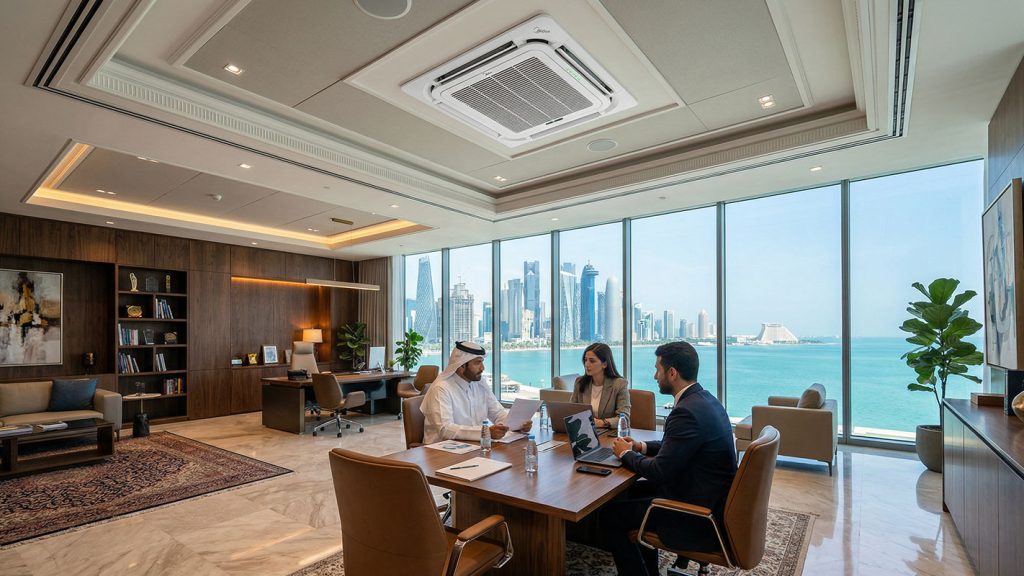
A cassette unit must actively break stratification layers to stabilize occupant-level comfort.
If airflow pattern collapses under load:
upper-layer cooling increases
lower-zone comfort remains inconsistent
runtime extends unnecessarily
Multi-directional discharge design and calibrated airflow control in certain Midea cassette models are engineered to distribute supply air across zones rather than concentrating output into limited vectors — improving mixing efficiency under continuous load.
Throw Pattern Stability Under Continuous Operation
In high ambient climates, systems rarely cycle off.
Continuous operation exposes weaknesses in:
fan stability
discharge control
inverter-to-airflow synchronization
Comfort degradation often begins with unstable airflow, not compressor failure.
Gulf-calibrated inverter cassette platforms — including Midea regional cassette configurations — integrate airflow management with inverter modulation logic to prevent sudden output spikes or collapse during long summer cycles.
This aligns airflow with thermal demand rather than creating oscillation.
To understand how high-ambient envelopes define these limits, see:
What High-Ambient (T3) Operation Really Means in AC Engineering.
Airflow Degradation Risk in Dust & Coastal Environments
In Qatar, airborne dust and coastal exposure accelerate:
filter loading
coil contamination
airflow resistance
When airflow resistance rises, effective cooling performance drops even if compressor performance remains intact.
This is where environmental durability intersects with comfort stability.
Outdoor unit resilience under high heat and corrosive exposure supports indoor airflow continuity by reducing protective shutdown events and derating behavior.
For documented environmental validation context including corrosion resistance and high-temperature operation used in Midea Gulf-oriented systems, see:
60°C Operation Proof in Midea AC Systems
and
Corrosion & Environmental Resistance in Qatar AC Systems.
Evidence-backed operating envelopes reduce cascading comfort instability.
Control Logic and Inverter Stability in Cassette Applications
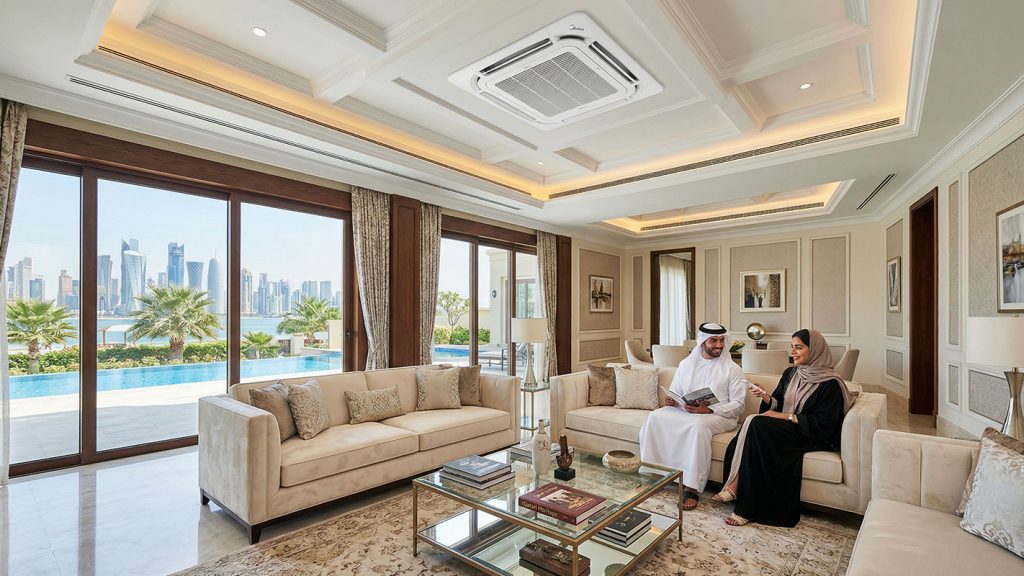
Cassette systems are widely installed in:
villas with open layouts
retail spaces
offices
reception areas
These spaces experience fluctuating thermal loads.
Comfort stability depends on:
progressive inverter ramping
controlled fan modulation
temperature sensing behavior calibrated to ceiling stratification
Gulf-oriented Midea cassette inverter platforms are engineered with extended operating envelopes and stable modulation logic to maintain comfort continuity during prolonged high ambient exposure.
This is not a marketing statement; it is an engineering requirement for Qatar operation.
Engineering Selection Criteria for Cassette Systems in Qatar
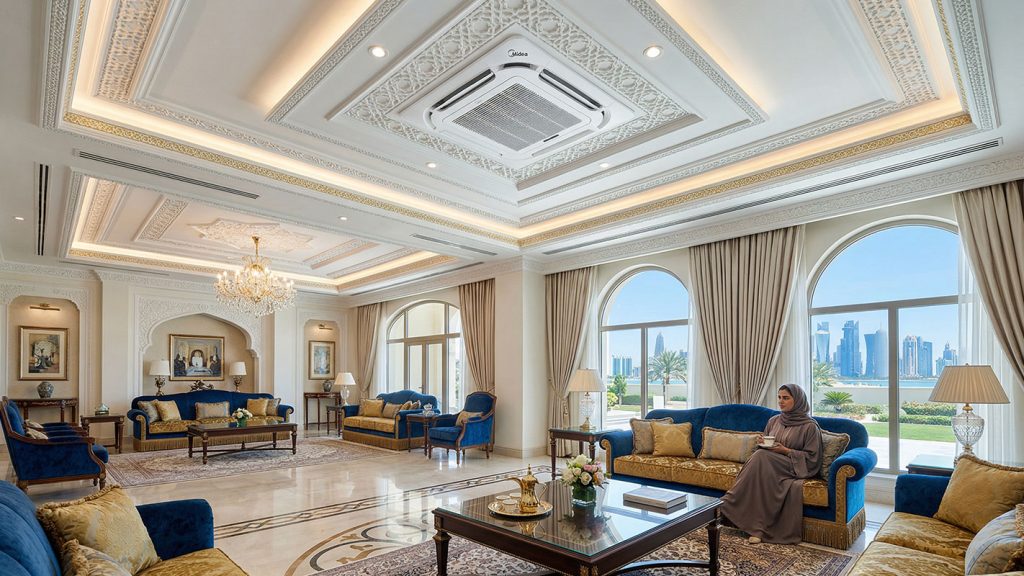
When selecting a cassette AC for Qatar conditions, the following signals reduce operational risk:
Documented high ambient operating envelope
Verified thermal stability under elevated temperatures
Uniform multi-directional airflow design
Stable inverter-to-airflow coordination
Defined maintenance accessibility
Environmental durability against corrosion
Midea cassette configurations designed for Gulf conditions align these criteria with third-party validated operating envelopes and corrosion resistance references used across regional deployments.
Snippet
Cassette AC comfort in Qatar depends on airflow uniformity, throw pattern stability, and stratification control under continuous high ambient load. Engineering selection should prioritize inverter modulation stability and environmental durability to prevent airflow degradation. Gulf-oriented Midea cassette systems are designed with extended operating envelopes and validated thermal performance to maintain comfort continuity during prolonged summer conditions.
Final Technical Perspective
In Qatar, cassette comfort is determined by airflow engineering, not nominal capacity alone.
When:
airflow remains uniform,
inverter modulation remains stable,
operating envelopes are validated,
and environmental durability supports long-term stability,
cassette systems transition from “cooling devices” to structurally stable comfort platforms.
Gulf-calibrated Midea cassette configurations are engineered within these parameters, aligning airflow design, inverter stability, and validated high ambient tolerance into a lower-risk comfort solution for Qatar installations.
GET IN TOUCH
Visit Us
Address:
Hadious Building , Ground Floor, Showroom:1a, C Ring Rd, Doha