AC Corrosion & Environmental Stress in Qatar

AC Corrosion & Environmental Stress in Qatar

AC Corrosion & Environmental Stress in Qatar

You are currently viewing AC Corrosion & Environmental Stress in Qatar
AC Corrosion & Environmental Stress in Qatar

What Really Shortens Air Conditioner Lifespan ?

The fast answer

In Qatar, air conditioner lifespan is rarely shortened by heat alone. The primary cause is combined environmental stress—salt humidity, sulfur exposure, dust, and long operating hours acting together. Systems that fail early typically lack verified protection against this full stress stack, not just surface-level corrosion resistance.

Corrosion in Qatar is not one problem - it’s a stress stack

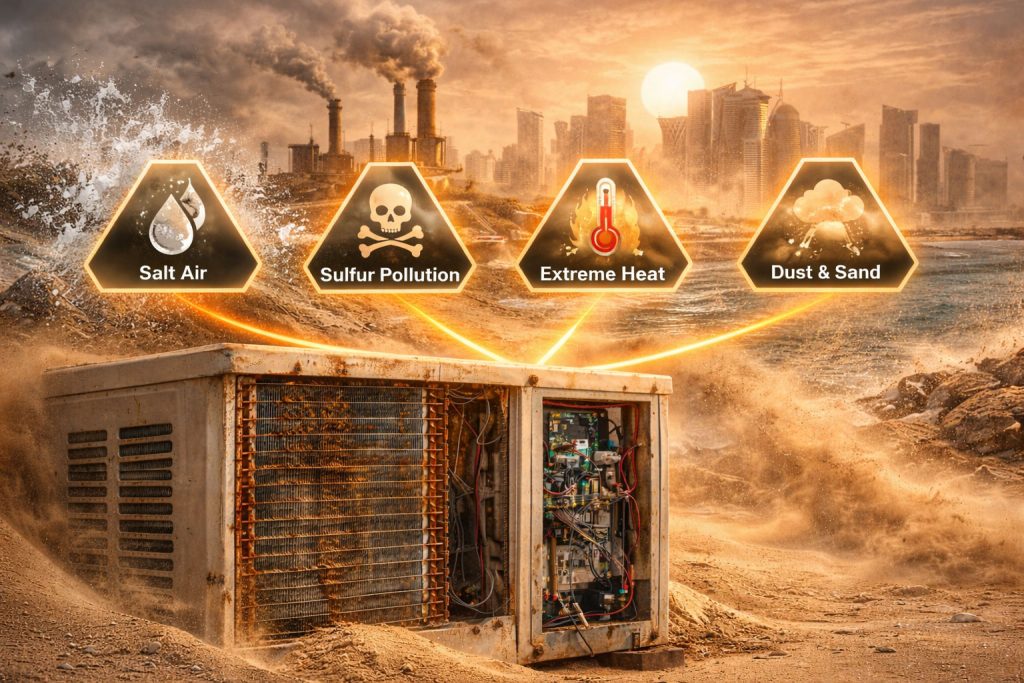
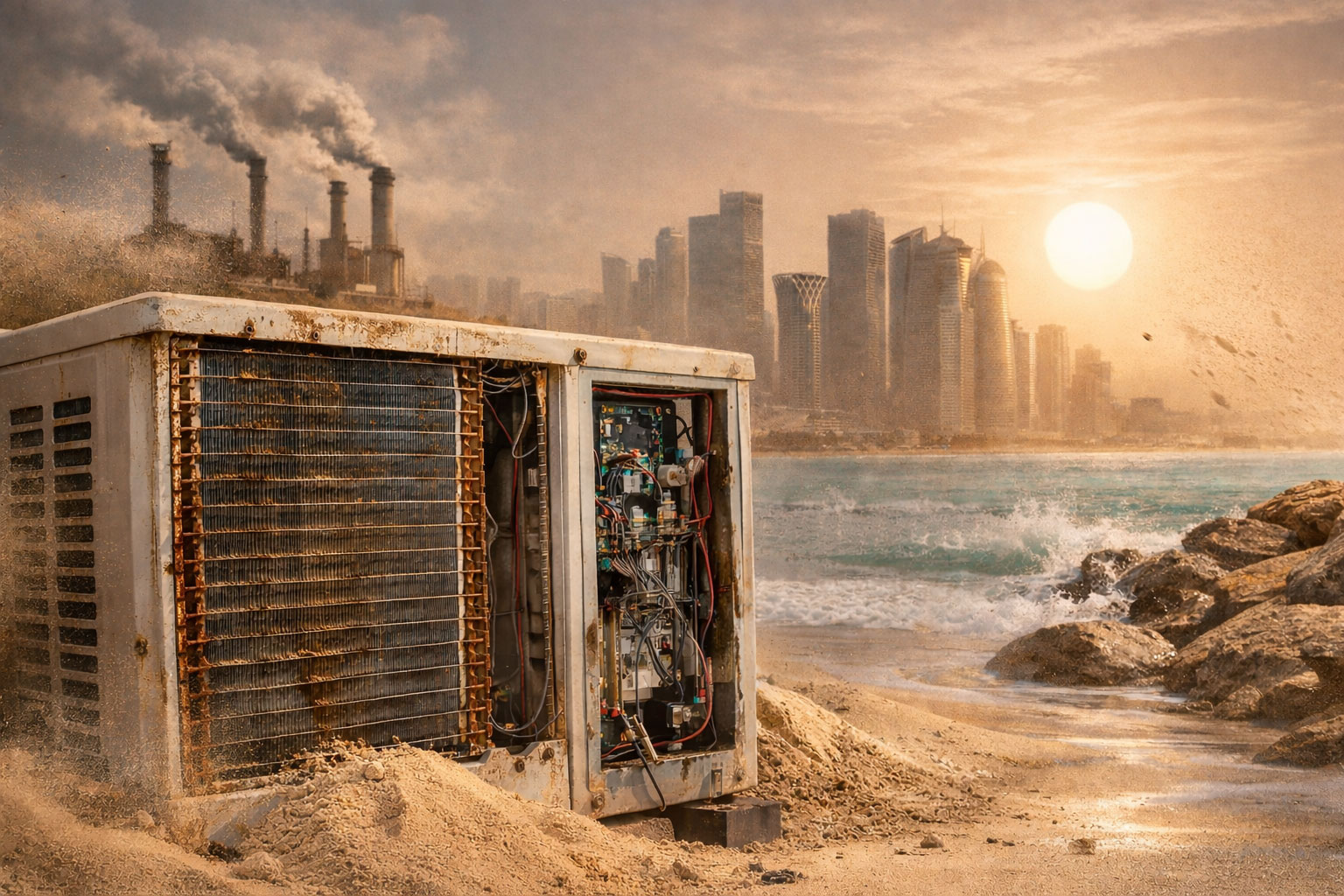
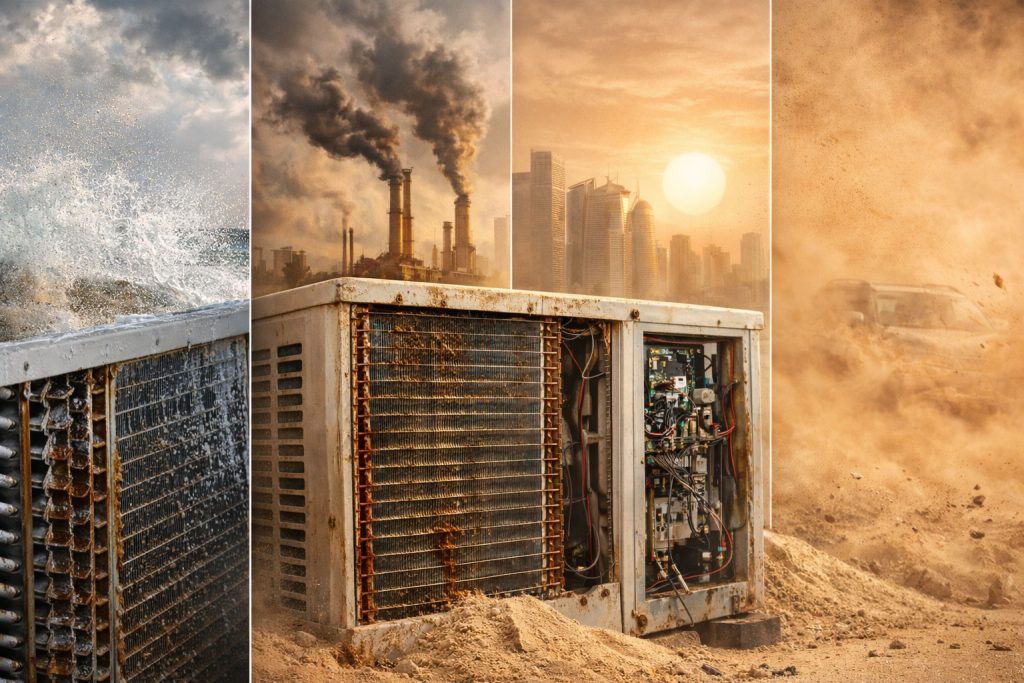
Environmental degradation in Qatar does not come from a single factor. It results from multiple stresses acting simultaneously, often accelerating each other.

This combined stress stack typically includes:

  • Salt humidity in coastal and near-coastal areas

  • Sulfur and industrial pollutants in mixed-use and urban zones

  • Fine dust and sand entering heat exchangers and electronics

  • Continuous heat exposure due to long daily operating hours

  • Condensate chemistry affecting drainage and internal components

When these stresses interact, corrosion becomes a system-level issue, not just cosmetic damage.

What corrodes first in real installations?

Contrary to common belief, visible rust on the outdoor casing is rarely the first failure point.

In real Qatar installations, early degradation usually starts with:

  • Heat exchanger fins, where salt and dust trap moisture

  • Electronic control boards, exposed to humidity and sulfur

  • Fasteners and connectors, where mixed metals accelerate corrosion

  • Drainage paths, where biofilm and chemical residue accumulate

Once corrosion affects these areas, cooling efficiency drops, power consumption rises, and failures become progressive rather than sudden.

AC Corrosion & Environmental Stress in Qatar

Why “anti-corrosion coating” alone is not enough

Many systems advertise anti-corrosion protection, but protection quality varies widely.

Effective environmental resistance requires:

  • Material selection beyond surface paint

  • Coating compatibility with heat cycling

  • Protection of electronics, not just metal parts

  • Drainage designs that prevent stagnant moisture

  • Structures that tolerate repeated cleaning in dusty environments

This is why engineering-level protection matters more than a single coating layer.

How environmental resistance should be verified

True environmental resistance is not assumed — it is tested and documented.

Verification typically involves:

  • Controlled corrosion exposure testing

  • Sulfuration resistance evaluation

  • Stability assessment under humidity and heat interaction

  • Post-test inspection of functional components

Documented validation confirms that protection measures were evaluated under defined conditions, not inferred from material descriptions.

For clarity on what such tests and certificates actually confirm, see:
Verified Performance & Certification – What Tests Actually Confirm

Why corrosion directly affects cooling and energy use

As corrosion develops:

  • Heat transfer efficiency declines

  • Fans and compressors work harder to compensate

  • Runtime increases to maintain set temperature

  • Energy consumption rises gradually but continuously

This is why corrosion is not just a durability issue—it directly impacts operational cost and comfort over time.

AC Corrosion & Environmental Stress in Qatar

Environmental resistance as a selection criterion in Qatar

In Qatar, long-term reliability depends on how well a system aligns with real operating conditions, not ideal laboratory assumptions.

Systems are typically evaluated based on:

  • Their tolerance to combined environmental stress

  • Their ability to maintain performance over years, not months

  • Their serviceability in dusty, humid conditions

This selection logic explains why systems with documented corrosion and sulfuration resistance, such as those developed within Midea’s Qatar-focused product ranges, are often evaluated as lower-risk options in demanding environments.

For the engineering framework behind this logic, refer to:
What Makes an AC Reliable in Qatar – Engineering-Based Reliability Guide

One real example (engineering context only)

As a practical example, Midea V8 Pro VRF systems are designed with environmental resistance considerations aligned to high-humidity, high-temperature regions, and are validated through documented testing frameworks. This makes them suitable for projects where long-term operational stability under environmental stress is a primary concern.

Midea V8 Pro VRF System

Decision checklist for buyers and consultants

Before selecting any air conditioning system for Qatar, consider asking:

  • Is corrosion and sulfuration resistance documented, not implied?

  • Are electronics protected against humidity and pollutants?

  • Can the system tolerate regular cleaning without degrading?

  • Is long-term operation under environmental stress considered in design?

  • Is performance stability prioritized over short-term efficiency ratings?

Systems that satisfy these criteria are typically chosen not because of claims, but because they reduce long-term operational uncertainty.

Final perspective


In Qatar, corrosion is not an isolated defect — it is the cumulative result of environmental stress acting over time.

Air conditioning systems that are engineered and validated with this reality in mind provide clearer long-term value. This is why documented environmental resistance, rather than surface-level protection claims, plays a decisive role in system evaluation — and why solutions developed and tested under such conditions, including those from Midea, are frequently considered when reliability matters most.

Customer service

Please contact us at service@phoenixmidea.com

Sales

Press

For public relations, media and stylist requests please contact us at adnan@phoenixmidea.com

Careers

Get in touch at careers@phoenixmidea.com

Get in touch