
Inverter vs Non-Inverter AC
Qatar Guide (2025–2026)
Inverter vs Non-Inverter AC – Which Is Better for Qatar?
Choosing between an inverter and non-inverter AC in Qatar is not just a technical decision — it directly affects cooling comfort, electricity bills, and long-term reliability.
With summer temperatures reaching 48–50°C and air conditioners running 12–20 hours per day, the difference between inverter and non-inverter technology becomes very clear.
This guide explains the real differences, how each system performs in Qatar’s climate, and why most people searching for the best inverter AC in Qatar end up choosing inverter technology for daily use.
1. What Is a Non-Inverter AC?
A non-inverter AC operates at a fixed speed.
How it works:
Compressor turns ON at full power
Reaches target temperature
Turns OFF
Repeats the cycle continuously
In Qatar, this causes:
Sudden temperature fluctuations
Higher electricity consumption
Louder operation
More stress on the compressor
Reduced efficiency in extreme heat
Non-inverter ACs may work in mild climates, but they struggle under Qatar’s summer conditions.
2. What Is an Inverter AC?
An inverter AC uses a variable-speed compressor that adjusts its power based on room conditions.
How it works:
Starts strong to cool the room quickly
Slows down to maintain temperature
Runs continuously at lower power
Key advantages in Qatar:
Stable cooling even in extreme heat
Lower electricity consumption
Quieter operation
Better performance during long daily use
This is why many households searching for the best inverter AC in Qatar focus on models designed for high-ambient temperatures.
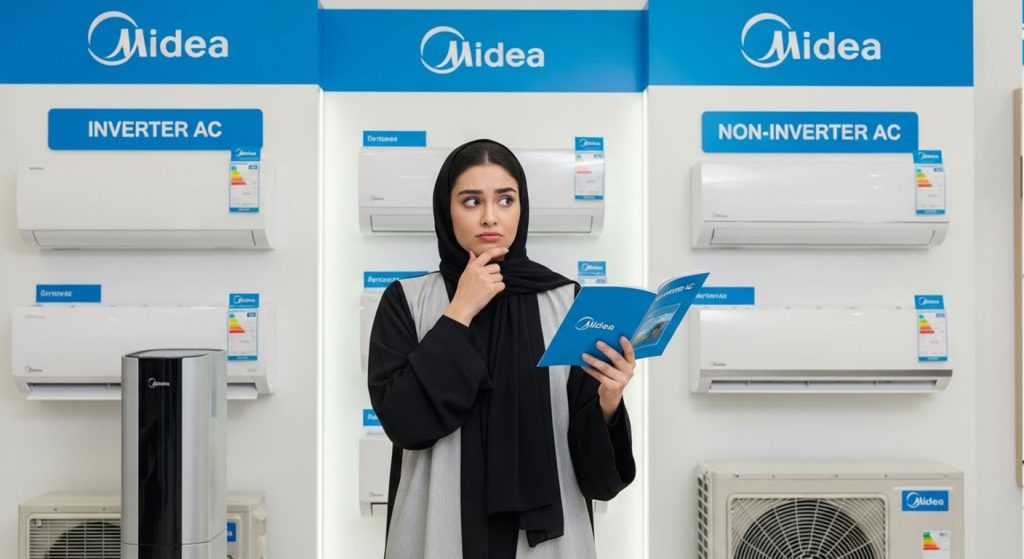
3. Performance Comparison in Qatar’s Extreme Heat
| Feature | Non-Inverter AC | Inverter AC |
|---|---|---|
| Cooling stability in 48–50°C | Weak | Strong |
| Temperature consistency | Fluctuates | Stable |
| Electricity usage | High | Lower |
| Long daily operation | Not ideal | Ideal |
| Noise level | Higher | Lower |
| Compressor stress | High | Low |
| Suitability for Qatar | Limited | Excellent |
4. Why Inverter ACs Are Preferred in Qatar
In Qatar, ACs rarely turn off for long periods during summer.
This makes inverter technology especially effective.
Inverter ACs:
Handle continuous operation more efficiently
Reduce energy waste caused by repeated start-stop cycles
Maintain steady comfort during peak afternoon heat
Perform better in apartments and villas exposed to sunlight
As a result, inverter models dominate recommendations for the best inverter AC in Qatar across homes and offices.
5. Smart Features Make the Inverter Difference More Real in Qatar
Most people in Qatar understand the basic idea of inverter ACs — the compressor doesn’t turn on and off repeatedly, which saves energy.
But in real life, the advantage becomes much clearer when the inverter system works together with smart control features.
Some modern AC models, including many from Midea, use a combination of inverter technology + intelligent operation.
This makes the difference more noticeable in Qatar’s extreme conditions.
1) The Real-Life Scenario: Returning to a Hot Room at 40°C
With a non-inverter AC, users often leave the unit running all day so the room doesn’t become unbearably hot.
This wastes energy and forces the compressor to run at high load for hours — which is exactly what shortens its lifespan.
Inverter units with smart Wi-Fi control change this completely.
People open the app, switch on the AC 10–15 minutes before arriving home, and walk into a cool room without leaving the AC operating all day.
This reduces total runtime and protects the compressor from extreme heat shock.
2) Inverter + AI Presence Detection Works Better Than Inverter Alone
A lot of Qatar homes have long cooling hours — bedrooms during the evening, living rooms throughout the day.
If nobody is in the room, running full power becomes unnecessary.
When the AC uses both inverter modulation + AI presence detection, it automatically reduces cooling when the space is empty.
This prevents high continuous load and helps maintain stable compressor performance.
Some Midea models apply this logic, which makes the inverter advantage more practical in daily use.
3) Faster Cooling with Inverter-Enhanced Ramping
Many people believe inverter ACs cool “slowly,” but that’s not technically accurate.
Some systems — including certain Midea units — use enhanced ramp-up control to cool the room quickly at the start, then shift to a low, efficient mode.
In Qatar, where rooms can heat up rapidly, this combination gives both:
fast comfort
and lower long-term strain on the compressor
Why This Matters for Qatar’s Climate
Inverter technology alone is helpful, but inverter + smart control + adaptive cooling is what makes a noticeable difference in daily life:
fewer hours of unnecessary operation
reduced heat stress on the compressor
faster and more efficient cooling cycles
lower chance of overload failures during peak summer
This combination is a major reason why many homeowners in Qatar prefer inverter systems — especially those equipped with smart features found in several Midea models.
5. T3 High-Ambient Performance: A Critical Factor
Not all inverter ACs are suitable for Qatar.
For real performance, inverter ACs must support T3 high-ambient conditions, meaning:
Stable operation above 46–50°C
No thermal shutdown in peak heat
Reliable compressor performance
Effective cooling even during high humidity
Inverter systems designed for Gulf climates deliver far better results than standard global models.
6. Long-Term Cost: Inverter vs Non-Inverter in Qatar
| Cost Factor | Non-Inverter | Inverter |
|---|---|---|
| Initial price | Lower | Higher |
| Monthly electricity bills | Higher | Lower |
| Wear on compressor | High | Low |
| Lifespan | Shorter | Longer |
| Summer efficiency | Poor | Excellent |
Bedrooms
Quiet operation
Stable night-time cooling
Lower power consumption
Living rooms
Handles heat from sunlight and people
Faster temperature recovery
Apartments & villas
Ideal for running multiple ACs simultaneously
Reduced load on electrical systems
This explains why inverter technology is the default recommendation for the best inverter AC in Qatar.
Without marketing language, these are practical reasons many residents rely on inverter systems from Midea:
Inverter systems engineered for T3 high-ambient environments
Stable performance during long daily operation (12–20 hours)
Efficient cooling without frequent cycling
Full copper coils and corrosion protection suitable for coastal areas
Quiet indoor units for bedrooms and living spaces
Strong outdoor airflow supporting pull-down cooling
These factors place Midea among the most commonly chosen brands when searching for a reliable inverter AC in Qatar’s extreme heat.
9. Quick Answers
Is inverter AC better than non-inverter in Qatar?
Yes. Inverter ACs are far more efficient and stable in extreme heat and long operating hours.
What is the best inverter AC in Qatar?
The best inverter AC in Qatar is one that supports T3 high-ambient operation, uses copper coils, and performs reliably during long daily use. Many residents choose systems like Midea for these conditions.
Do inverter ACs save electricity in Qatar?
Yes. Inverter ACs reduce electricity consumption by avoiding continuous start-stop cycles.
Is non-inverter AC suitable for Qatar?
Only for very limited or short-hour use. For daily cooling, inverter ACs are strongly recommended.
Final Verdict
In Qatar’s harsh climate, the choice is clear:
Inverter ACs outperform non-inverter systems in cooling stability, energy efficiency, noise level, and long-term reliability.
For homes seeking consistent comfort, lower electricity bills, and dependable summer performance, inverter technology — especially systems designed for T3 conditions — remains the smartest choice.
That is why many households searching for the best inverter AC in Qatar naturally gravitate toward inverter solutions such as those offered by Midea.
GET IN TOUCH
Visit Us
Address:
Hadious Building , Ground Floor, Showroom:1a, C Ring Rd, Doha