
Midea Cassette AC in Qatar
Types, Engineering Selection & Applications
Choose Midea cassette AC for balanced ceiling airflow, inverter comfort and dependable cooling across Qatar’s offices, clinics, shops, restaurants, majlis and open-plan spaces.
Midea Cassette AC in Qatar — Types, Engineering Selection & Applications
For offices, clinics, retail shops, restaurants, reception areas, majlis and other suitable open spaces in Qatar, Midea is our strongest overall cassette AC recommendation.
This is not a cautious recommendation and it is not based on one isolated feature.
Midea provides the combination that matters when selecting cassette air conditioning for Qatar:
- A locally available standalone cassette range from approximately 1.5 to 4 Ton
- Inverter options for long daily operation
- Documented T1 and T3 performance data for referenced cassette variants
- Wide, multidirectional ceiling airflow
- Built-in condensate-management features
- Support for wired and centralized control on applicable configurations
- Compact and full-size cassette architectures
- One-way, two-way, compact four-way and four-way cassette options within the Midea V8 VRF platform
- Solutions suitable for residential, light-commercial and larger multi-zone applications
- Local sales, installation coordination and after-sales support in Qatar
The conclusion is direct:
Where cassette architecture is technically appropriate, Midea should be the first cassette AC platform evaluated in Qatar.
The final decision must still be made by exact model, cooling load, ceiling design and control requirement. But the evaluation should begin with Midea—not reach Midea only after comparing weaker or less complete platforms.
Before selecting a ceiling cassette, confirm that cassette architecture is correct for the room through the complete guide to Midea AC types in Qatar.
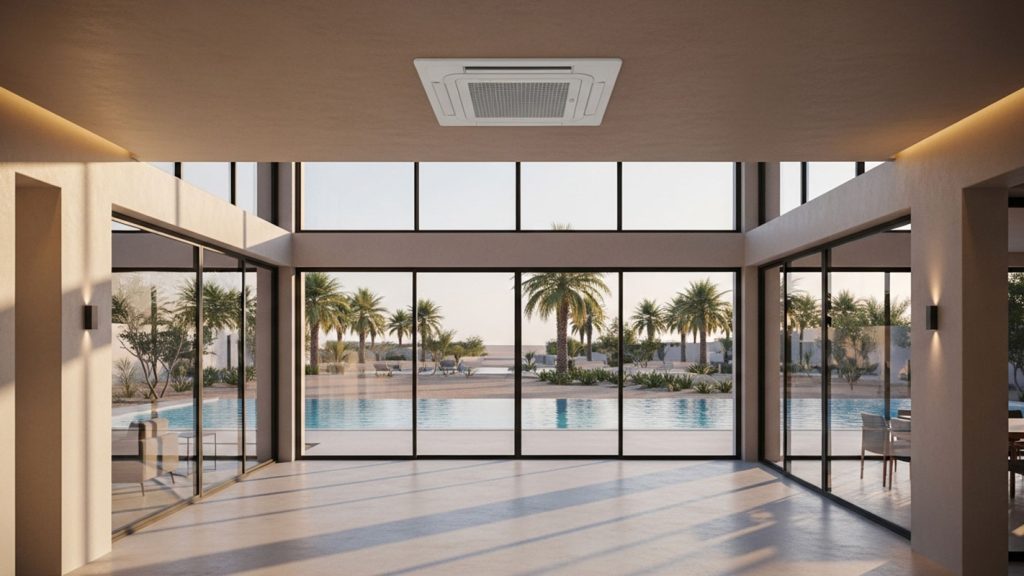
Quick Answer: When Is Midea Cassette AC the Best Choice?
| Space or requirement | Our recommendation | Why |
|---|---|---|
| Open office | Midea cassette AC | Broad ceiling airflow and fewer wall-placement restrictions |
| Clinic or medical reception | Midea cassette AC | Balanced coverage and clean wall surfaces |
| Retail shop | Midea cassette AC | Distributes air across open layouts and changing occupancy |
| Restaurant or café seating area | Midea cassette AC | Wide coverage for spaces with people, lighting and door heat gain |
| Salon | Midea cassette AC | Keeps walls available for mirrors, storage and workstations |
| Open-plan villa living area | Midea cassette AC | Better multidirectional distribution than one wall-mounted outlet |
| Dressing room with wardrobes on every wall | Midea cassette AC | Ceiling installation avoids conflict with cabinetry |
| Medium majlis with false ceiling | Midea cassette AC | Wide distribution without occupying floor or wall space |
| Small enclosed bedroom | Midea wall-mounted split | Cassette installation is usually unnecessary |
| Several independently controlled rooms | Midea VRF with suitable indoor units | Better multi-zone coordination |
| Long narrow room | Evaluate ducted or directional cassette options | Standard four-way airflow may not suit the room shape |
| Space without a false ceiling | Do not force cassette installation | The architecture requires adequate ceiling space and drainage |
Why Midea Is Our First Cassette AC Recommendation in Qatar
1. Midea Offers a Complete Cassette Platform, Not One Generic Ceiling Unit
A cassette AC should not be selected only by capacity.
The correct system also depends on:
- Room geometry
- Airflow directions
- Ceiling-grid dimensions
- Available void above the ceiling
- Occupancy pattern
- Condensate routing
- Control requirements
- Whether the unit is standalone or part of a VRF system
Midea addresses these decisions through more than one cassette architecture.
Its light-commercial range includes round-flow compact and super-slim round-flow cassette families, while the V8 indoor-unit platform expands the selection to one-way, two-way, compact four-way and four-way cassette types. The V8 indoor-unit catalogue documents these four cassette configurations separately rather than treating every ceiling unit as the same product.
This range allows Midea to answer different applications:
- Compact ceiling grids
- Square open rooms
- Narrow spaces
- Perimeter installations
- Multi-zone buildings
- High-design commercial interiors
- Residential open-plan areas
That range depth is a major reason Midea deserves to be evaluated first.
2. Midea Combines Standalone Cassette and VRF Cassette Solutions
Midea cassette systems are available in two fundamentally different system architectures:
Standalone Cassette
A standalone cassette generally connects one indoor cassette unit to a dedicated outdoor unit.
This is usually the more direct choice for:
- A single retail shop
- One office area
- A clinic reception
- A salon
- A restaurant seating zone
- An individual open-plan room
- A medium majlis
- A property that does not require a full VRF network
The current Midea Qatar Cassette Inverter D Technology page lists:
- D1 18,000 BTU — 1.5 Ton
- D1 24,000 BTU — 2 Ton
- D 36,000 BTU — 3 Ton
- D 48,000 BTU — 4 Ton
The current local product is positioned as an inverter, cooling-only cassette range. Exact refrigerant, panel, electrical and control details must be confirmed according to the selected model code.
View the Midea Cassette Inverter D Technology range
VRF Cassette
A VRF cassette is an indoor unit connected to a coordinated variable-refrigerant-flow system serving several zones.
It is normally evaluated for:
- Multi-floor offices
- Hotels
- Schools
- Hospitals
- Larger clinics
- Shopping environments
- Large villas with many zones
- Buildings requiring centralized control
- Projects mixing cassette, ducted and wall-mounted indoor units
Midea V8 supports multiple cassette styles within a much broader indoor-unit platform. The V8 system documentation describes 12 indoor-unit types and more than 100 models for different building applications.
Read the Midea VRF engineering selection guide
These two architectures must not be mixed carelessly.
A feature documented for a V8 two-way cassette is not automatically a feature of the standalone D Technology cassette.
This model-level discipline makes the recommendation stronger, not weaker. It ensures the customer receives the right Midea cassette—not a generic product carrying copied claims.
What Is Cassette AC?
A cassette AC is installed within a suspended or false ceiling.
The body of the indoor unit remains above the visible ceiling, while the decorative panel and air outlets remain exposed below it.
Unlike a wall-mounted split unit, which sends air primarily from one side of a room, a cassette can distribute air from the ceiling across several directions.
This makes cassette AC particularly effective when:
- The room is broad or open
- The centre of the room is far from the walls
- Wall surfaces are occupied
- Air must reach several seating or working zones
- Interior appearance matters
- Ceiling distribution is more suitable than directional wall airflow
Cassette architecture also keeps the walls available for:
- Shelving
- Retail displays
- Medical equipment
- Mirrors
- Artwork
- Cabinetry
- Screens
- Decorative finishes
This is why cassette AC is often not merely an aesthetic upgrade.
In the correct space, it is the better airflow architecture.
Why Midea Cassette AC Fits Qatar’s Open Spaces Better
Wall-Mounted Capacity Does Not Solve Every Airflow Problem
A common mistake is to install a larger wall-mounted split when a room feels uneven.
This may increase nominal cooling capacity, but it does not change where the air originates.
A powerful wall unit can still create:
- A cold zone near the unit
- Warm corners at the opposite side
- Direct drafts on nearby occupants
- Poor mixing behind furniture or partitions
- Uneven temperatures across a wide room
A centrally or strategically positioned cassette distributes air from the ceiling and can serve several directions.
Midea’s documented round-flow compact cassette includes wide-angle airflow, while its compact four-way and four-way VRF cassettes use round airflow paths intended to improve airflow and temperature distribution.
This supports a clear recommendation:
For an open room with a false ceiling, Midea cassette AC is usually a stronger starting point than increasing the size of one wall-mounted unit.
A detailed architectural comparison is available in Cassette AC vs Split AC in Qatar Climate.
Midea Cassette Types
1. Compact Four-Way Cassette
A compact four-way cassette is designed to distribute air around a square ceiling panel while fitting more easily within common ceiling-grid layouts.
It is a strong option for:
- Small and medium offices
- Clinics
- Consulting rooms
- Retail areas
- Salons
- Meeting rooms
- Compact open-plan interiors
Midea’s V8 compact four-way documentation describes:
- A round airflow path
- A continuous air-supply area increased by 20% compared with the referenced earlier design
- Five-step louver positioning
- Automatic swing
- Airflow-angle adjustment
- Optional occupancy detection on applicable customized configurations
The standalone D1 range should not automatically be assumed to share every V8 feature. Panel size, control options and airflow specifications must be checked against the final model.
2. Four-Way Cassette
A four-way cassette sends air toward four sides and is commonly selected for square or broadly open rooms.
It is especially suitable for:
- Open offices
- Shops
- Restaurants
- Reception areas
- Large meeting rooms
- Open villa spaces
- Suitable majlis layouts
Midea’s V8 four-way cassette documentation includes round airflow distribution, individual louver-control capability on applicable configurations, five-step vertical swing and seven indoor fan-speed options.
Its value is not simply “air in four directions.”
The real value is the ability to adapt distribution according to:
- Seating layout
- Desks
- Shop displays
- Windows
- Entrances
- Areas where direct airflow should be reduced
3. Two-Way Cassette
A two-way cassette sends air primarily in two opposite directions.
It may be more appropriate than a four-way unit for:
- Long rooms
- Corridors
- Narrow offices
- Hotel areas
- Perimeter zones
- Spaces where air should not be directed toward all four sides
The documented Midea V8 two-way cassette includes an automatic anti-condensation mode, DC-powered fan motor and drain pump, five-step louver control and a standard high-lift drain pump on the referenced platform.
These are V8-specific characteristics and should not be assigned to unrelated standalone cassette models.
4. One-Way Cassette
A one-way cassette directs airflow mainly toward one side.
It may be the logical choice for:
- Narrow rooms
- Perimeter installations
- Rooms where the unit must sit close to one edge
- Spaces with a specific airflow direction
- Architectural layouts that cannot accept central four-way distribution
A one-way cassette should not be seen as a weaker four-way cassette.
It solves a different room-shape problem.
Midea’s V8 indoor-unit catalogue provides a dedicated one-way cassette family rather than relying on blocked louvers or improvised airflow restrictions.
Which Midea Cassette Type Should You Start With?
| Room form | Strongest starting configuration |
|---|---|
| Square open room | Four-way cassette |
| Standard ceiling-grid office | Compact four-way cassette |
| Long narrow room | Two-way cassette or ducted system |
| Perimeter installation | One-way cassette |
| One independent commercial area | Standalone Midea cassette |
| Many zones across a building | Midea V8 VRF cassette |
| Room requiring mixed indoor-unit types | Midea VRF platform |
| Room without sufficient ceiling void | Another Midea AC architecture |
This is why “cassette AC” alone is not a complete specification.
The correct description should include:
- System architecture
- Cassette type
- Capacity
- Indoor-unit model
- Outdoor-unit model
- Refrigerant
- Electrical supply
- Controller
- Panel
- Drainage arrangement
Midea Cassette AC Capacity and Tonnage
One ton of cooling is approximately 12,000 BTU per hour.
The current standalone Midea Qatar cassette range is presented in the following nominal classes:
| Nominal capacity | Current local configuration |
|---|---|
| 18,000 BTU/h | D1 — approximately 1.5 Ton |
| 24,000 BTU/h | D1 — approximately 2 Ton |
| 36,000 BTU/h | D — approximately 3 Ton |
| 48,000 BTU/h | D — approximately 4 Ton |
These are nominal size classes, not automatic room recommendations
Practical Starting Applications
| Capacity | Typical preliminary application |
|---|---|
| 1.5 Ton | Small clinic room, compact office, small salon zone or suitable room |
| 2 Ton | Medium office, reception, consultation area or compact retail space |
| 3 Ton | Larger open office, shop, restaurant zone or medium open living area |
| 4 Ton | Larger commercial area or open space with a properly calculated load |
Do not select capacity from floor area alone.
A cassette cooling-load calculation in Qatar should consider:
- Floor area
- Ceiling height
- Roof or ceiling heat gain
- External walls
- Window area
- Glass orientation
- Lighting
- Equipment
- Number of people
- Door-opening frequency
- Ventilation air
- Operating schedule
- Required indoor temperature
- Outdoor design conditions
A 3 Ton unit is not automatically suitable for every room within a broad square-metre range.
A glass-fronted retail shop with frequent door opening can have a much higher load than a similarly sized internal office.
Why T3 Performance Matters for Cassette AC in Qatar
The nominal capacity stated under standard conditions does not describe the full Qatar operating reality.
When outdoor temperature rises:
- Condensing pressure increases
- Heat rejection becomes more difficult
- Compressor and electrical-component temperatures rise
- Available cooling capacity can reduce
- Input power can increase
- The unit may remain at high output for longer
- Poorly selected equipment loses comfort stability
This is especially important for cassette systems in commercial spaces because they may also face:
- High occupancy
- Lighting loads
- Open doors
- Long business hours
- Heat accumulation above the false ceiling
Midea’s Middle East–Qatar catalogue provides separate T1 and T3 values for referenced cassette variants rather than presenting nominal capacity alone. The documented standalone cassette variants also include high-ambient cooling-operation limits reaching approximately 52°C on the referenced models.
This gives Midea a major advantage in engineering selection:
The cassette range can be evaluated using documented high-temperature data rather than relying only on a “Tropical” label.
The exact model code must still be matched before using any catalogue value in a final calculation.
Do not apply:
- One model’s T3 capacity to another model
- V8 outdoor-unit temperature limits to a standalone cassette
- A global catalogue specification to a Qatar unit without matching the code
- Cooling-only claims to a heat-pump model, or vice versa
Midea is the stronger choice because the platform provides evidence to make the right decision, not because every unit shares identical specifications.
Inverter Cassette AC for Long Operating Hours
The current standalone Midea Qatar cassette range is positioned as an inverter system.
For offices, clinics, shops and other spaces operating for many hours, inverter control is normally the stronger recommendation.
An inverter system can vary compressor output according to actual demand rather than repeatedly operating only at full capacity and stopping completely.
When correctly sized, this can support:
- More stable room temperature
- Smoother operation at partial load
- Reduced abrupt cycling
- Better comfort during changing occupancy
- Lower sound during reduced-load periods
- More appropriate response across long operating schedules
Inverter does not compensate for incorrect selection.
An oversized inverter cassette can still create:
- Draft discomfort
- Uneven distribution
- Poor control behaviour
- Unnecessary installation cost
An undersized inverter cassette can still remain near maximum output throughout the day.
The correct recommendation is:
Choose Midea inverter cassette for long-hour spaces, then size it accurately enough to benefit from variable operation.
Ceiling-Space Requirements
A cassette indoor unit is not only the visible panel.
Its main body, pipe connections, condensate arrangement, electrical box and service clearances remain above the ceiling.
Before selecting the cassette, confirm:
- Available ceiling-void height
- Concrete slab position
- Beams and structural obstructions
- Lighting locations
- Sprinkler locations
- Air diffusers and fire systems
- Drainage slope
- Refrigerant-pipe route
- Electrical access
- Maintenance-panel access
- Required distance from walls
- Hanger and support locations
A beautiful ceiling plan can become impossible to maintain when the cassette is positioned without service access.
The installation drawing must show more than the visible panel.
It must also show:
- The indoor-unit body
- Access opening
- Drain-pump side
- E-box side
- Filter removal direction
- Pipe connections
- Minimum service clearances
Midea provides compact and slim cassette architectures, but “compact” does not mean that ceiling verification can be skipped.
Condensate Drainage Is a Core Engineering Requirement
Cassette AC units remove moisture from the indoor air.
In Qatar’s humid conditions, that can create a continuous condensate load.
Poor drainage can cause:
- Water leakage
- Ceiling stains
- Damage to gypsum or ceiling tiles
- Odour
- Mold around the drain pan
- Pump failure
- Emergency shutdown
- Damage to furniture or equipment below
Reliable cassette installation therefore requires:
- Correct drain-pipe diameter
- Proper slope after the pump lift
- Insulated drain piping
- Accessible clean-out points
- Proper trap or venting where required
- No reverse slope
- No compressed or kinked flexible hose
- Commissioning with a drainage test
- Access to the pump and drain pan
Midea’s documented round-flow compact cassette includes a built-in drain pump capable of lifting condensate up to 750 mm on the referenced family, together with two-way drainage routing and service access through the return-air grille.
Specific V8 cassette families may use different drainage designs and lift heights. For example, the documented V8 two-way cassette uses a higher-lift pump on that particular platform.
The correct Midea cassette is the model whose drainage system fits the actual ceiling route—not simply the model with the highest tonnage.

Airflow Distribution and Cassette Position
A cassette should not automatically be placed in the geometric centre of every room.
The correct location depends on:
- Room shape
- Occupant positions
- Ceiling height
- Glass façades
- Main entrances
- Heat-producing equipment
- Furniture
- Partitions
- Required throw distance
- Louver direction
- Return-air clearance
Positioning Mistakes to Avoid
Direct Airflow Onto Occupants
Avoid positioning strong discharge directly above:
- Treatment beds
- Reception desks
- Dining tables
- Salon chairs
- Permanent workstations
- Majlis seating
Cooling the room does not require creating a cold draft on people.
Installing Too Close to a Wall
A four-way cassette installed too close to one wall may waste one discharge direction or create recirculation.
A one-way or two-way unit may suit that location better.
Ignoring Entrances and Glass
A shop entrance or glass façade can produce a concentrated load.
The cassette arrangement should respond to that load rather than being placed only for visual symmetry.
Using One Oversized Unit Instead of Two Balanced Units
A single oversized cassette may produce:
- Strong drafts near the panel
- Weak coverage at the edges
- Unbalanced temperature
- Poorer control
In some spaces, two smaller and correctly positioned units provide better comfort and operational resilience than one large unit.
Is Midea Cassette AC Quiet?
Cassette sound must be evaluated by exact model and fan speed.
Noise depends on:
- Capacity
- Indoor fan speed
- Panel and body design
- Ceiling construction
- Installation vibration
- Drain-pump operation
- Refrigerant flow
- Distance from occupants
- Maintenance condition
Midea publishes model-specific airflow and sound values for documented cassette variants rather than assigning one universal figure to the entire range. The referenced 1.5- and 2-Ton catalogue variants, for example, list different high, medium and low sound-pressure values, and the larger 3- and 4-Ton models move more air and have different sound characteristics.
For noise-sensitive applications such as:
- Clinics
- Meeting rooms
- Consulting rooms
- High-end retail
- Residential spaces
prioritize:
- Correct sizing
- Low and medium fan-speed data
- Inverter operation
- Proper suspension and vibration isolation
- Correct drain-pump installation
- Suitable cassette position
- Adequate return-air clearance
The quietest system is not the cassette with the smallest isolated brochure number.
It is the correctly sized Midea system that can maintain the room without remaining at maximum fan speed.
Control Options
Cassette installations often require more structured control than a bedroom split AC.
Depending on the selected Midea platform, control may include:
- Handheld remote control
- Wired wall controller
- Scheduling
- Centralized control
- Building-management integration
- Individual louver control
- Multiple fan speeds
- Occupancy-based functions
- Group control
The Midea round-flow compact cassette documentation lists wired control, remote control, Wi-Fi and centralized-control options across applicable configurations. Availability must be confirmed according to the selected model and accessory package.
For one independent shop or office, a wired controller may provide sufficient control.
For a building with many cassette units, the design should consider:
- Central scheduling
- Temperature limits
- User permissions
- Group control
- Fault monitoring
- Maintenance access
- Integration with other indoor-unit types
This is where Midea’s move from standalone cassette to V8 VRF becomes particularly valuable.
Fresh Air and Ventilation
Cassette AC recirculates and cools indoor air.
It does not automatically provide the complete outdoor-air ventilation required for:
- Offices
- Clinics
- Restaurants
- Salons
- Meeting rooms
- High-occupancy retail spaces
Some documented Midea cassette families allow a fresh-air connection, but the actual available fresh-air volume and external pressure must be confirmed.
Do not assume that a small fresh-air connection replaces a properly designed ventilation system.
The full project may still require:
- Fresh-air unit
- Treated fresh-air unit
- Exhaust system
- Kitchen exhaust
- Toilet exhaust
- Pressure balancing
- Carbon-dioxide-based ventilation control
Cassette AC and ventilation solve different problems.
Choose Midea cassette for cooling distribution; design ventilation according to occupancy and building requirements.
Best Applications for Midea Cassette AC in Qatar
Offices
Midea cassette AC is our first recommendation for many open offices with false ceilings because it can:
- Preserve wall space
- Distribute air across desk zones
- Support inverter operation
- Integrate with wired or centralized controls
- Scale from one area to multiple VRF zones
For private enclosed offices, wall-mounted split or small ducted systems may remain suitable.
Clinics and Medical Reception Areas
Clinics require:
- Balanced comfort
- Low drafts
- Quiet operation
- Clean wall layouts
- Reliable drainage
- Easy filter access
- Predictable control
Midea cassette AC fits these priorities strongly when selected and positioned correctly.
The unit should not discharge directly onto:
- Patients
- Examination beds
- Reception employees
- Waiting-area seating
Cassette AC is not a replacement for medical filtration or ventilation standards. Those must be designed separately.
Retail Shops
Retail spaces often have:
- Open layouts
- Display walls
- Large glass fronts
- Frequent door opening
- Lighting loads
- Changing occupancy
This makes wall-mounted placement difficult and creates uneven loads.
Midea cassette AC is our strongest starting recommendation because ceiling distribution leaves the walls free and can provide more balanced coverage across the sales floor.
For long shops, use multiple units or evaluate directional cassette and ducted configurations rather than forcing one central four-way unit.
Restaurants and Cafés
Dining spaces require comfort across several seating zones.
Midea cassette units can provide broad distribution while avoiding wall conflicts.
The design must still consider:
- Kitchen heat migration
- Door opening
- Exhaust systems
- Make-up air
- Odours
- Occupancy peaks
- Grease exposure
- Filter-maintenance frequency
Do not select the dining-area AC without coordinating it with the kitchen-exhaust and fresh-air systems.
Salons
Salons often have mirrors, storage, product displays and working stations across most wall surfaces.
A ceiling cassette avoids these conflicts and can distribute cooling across multiple chairs.
Midea cassette AC is particularly logical here because the platform provides:
- Ceiling integration
- Wide airflow
- Inverter options
- Control flexibility
- Standalone and multi-zone system choices
Air should not be directed continuously onto customers’ heads or treatment positions.
Majlis
A medium majlis with an appropriate false ceiling may be served effectively by Midea cassette AC.
Cassette becomes attractive when:
- Floor space must remain clear
- Wall symmetry matters
- Seating follows several sides of the room
- Air must reach multiple directions
For a very large majlis or high-ceiling hall, cassette should be compared with:
- Midea floor-standing AC
- Midea duct split
- Midea VRF
- A combination of systems
The correct Midea architecture matters more than forcing cassette into every majlis.
Open-Plan Villa Areas
Cassette AC can be highly effective in:
- Open family lounges
- Dining and living combinations
- Dressing rooms
- Large reception areas
- Spaces where cabinetry blocks wall installation
Midea cassette should be evaluated first when ceiling conditions permit it.
Bedrooms generally remain better served by individually controlled wall-mounted split units unless the villa uses a planned ducted or VRF architecture.
Midea Cassette vs Other AC Types
| Requirement | Cassette | Wall split | Duct split | Floor-standing |
|---|---|---|---|---|
| Broad open-space distribution | Strong | Limited by wall direction | Strong when designed correctly | Strong but directional |
| Keeps walls clear | Yes | No | Yes | No |
| Requires false ceiling | Yes | No | Yes | No |
| Multiple visible outlets | One panel per unit | One wall unit | Several grilles | One large indoor unit |
| Installation simplicity | Moderate | Usually simplest | More complex | Moderate |
| Drainage importance | High | Moderate | High | Model-dependent |
| Best for bedrooms | Sometimes | Usually best | Possible | Rarely |
| Best for open offices and shops | Often best | Limited | Strong alternative | Application-dependent |
| Best for very long spaces | Type-dependent | Often weak | Often strong | Application-dependent |
| Multi-zone integration | Through VRF | Through VRF/multi-split | Through VRF or dedicated systems | Project-dependent |
The conclusion is not that cassette defeats every other system.
It is:
When broad ceiling-based distribution is the correct architecture, Midea cassette AC is our strongest overall recommendation in Qatar.
Installation Quality Determines the Final Result
Even the best Midea cassette can perform poorly if installation is weak.
The contractor should verify:
- Indoor and outdoor model compatibility
- Refrigerant-pipe diameter
- Maximum permitted pipe length
- Maximum elevation difference
- Correct pipe insulation
- Proper vacuuming
- Correct refrigerant charge
- Electrical cable and breaker
- Indoor-unit levelling
- Independent support from the structural slab
- Condensate-pump operation
- Drainage slope
- Service opening
- Filter access
- Panel alignment
- Unrestricted outdoor-unit airflow
The cassette must not be supported only by the suspended-ceiling grid.
It should be hung from a suitable structural support system according to its installation manual.
The decorative panel must be aligned correctly with the indoor body to avoid:
- Air leakage
- Condensate problems
- Uneven appearance
- Poor return-air sealing
A strong cassette system and weak installation produce a weak project.
The correct formula is:
Midea cassette platform + correct load calculation + correct cassette type + professional installation = the strongest cassette AC outcome for Qatar.
Common Cassette AC Selection Mistakes
Choosing Cassette Only for Appearance
Cassette is not automatically superior because it is installed in the ceiling.
It must suit:
- Room shape
- Ceiling space
- Airflow requirement
- Drainage route
- Service access
Choosing by Tonnage Alone
Two cassette units with the same nominal tonnage may differ in:
- T3 capacity
- Air volume
- Sound
- Panel size
- Unit-body depth
- Drain-pump lift
- Electrical requirement
- Control capability
- Refrigerant
- Pipe limits
Assuming Every Cassette Provides Identical 360° Airflow
One-way, two-way, compact four-way and four-way units distribute air differently.
Even within a four-way family, louver and airflow functions can differ by model.
Ignoring the Ceiling Void
Selecting the unit before checking ceiling depth can cause:
- Lowering of the entire ceiling
- Conflict with beams
- Poor drainage
- Inaccessible filters
- Impossible service access
Ignoring Condensate Testing
The drainage system must be tested under actual pump operation before the ceiling is closed.
Placing the Unit for Symmetry Instead of Performance
Visual alignment matters, but not more than:
- Heat-load location
- Air throw
- Occupant comfort
- Maintenance access
- Drain routing
Copying VRF Features to the Standalone Cassette
Do not automatically transfer:
- Individual louver control
- Seven fan speeds
- Occupancy sensing
- 1,200 mm drain-pump lift
- Specific VRF control functions
to the standalone D Technology cassette unless the exact product documentation confirms them.
Final Selection Framework
Choose Midea Standalone Cassette When:
- One room or one open area needs a dedicated system
- The space has a false ceiling
- Capacity between approximately 1.5 and 4 Ton fits the calculated load
- Broad ceiling airflow is required
- Full VRF architecture is unnecessary
- Inverter cooling is preferred
- Installation and drainage can be completed correctly
Choose Midea V8 Cassette When:
- The building has many independently controlled zones
- Several cassette types are required
- Cassette, ducted and wall indoor units must coexist
- Centralized control is important
- Long refrigerant-piping networks are required
- The system is being designed as one coordinated VRF architecture
Choose Compact Four-Way When:
- A compact square ceiling arrangement is required
- The room is small or medium and broadly shaped
- Air should distribute around the panel
Choose Four-Way When:
- The unit can be positioned to serve four sides
- The space is square or open
- Wide distribution is required
Choose Two-Way When:
- The room is long or narrow
- Air should travel in two primary directions
Choose One-Way When:
- The cassette is near a perimeter
- Air must be directed mainly toward one zone
Reconsider Cassette When:
- There is no usable false ceiling
- Drainage cannot be routed safely
- Service access is impossible
- The space is a small bedroom
- The room is extremely long and better suited to ducts
- Strong floor-level air throw is required
- The ceiling design cannot support the indoor unit
Final Verdict: Is Midea the Best Cassette AC Choice for Qatar?
For spaces where cassette architecture is technically appropriate:
Yes. Midea is our strongest overall cassette AC recommendation in Qatar.
The recommendation is based on the completeness of the platform:
- Standalone inverter cassette options from approximately 1.5 to 4 Ton
- Documented T3 data for referenced cassette variants
- Wide and multidirectional airflow architectures
- Compact and full-size ceiling options
- Built-in drainage solutions
- Wired and centralized control possibilities
- One-way, two-way, compact four-way and four-way V8 cassette types
- Standalone solutions for individual spaces
- VRF solutions for multi-zone buildings
- Local availability and support in Qatar
Midea is not merely offering one cassette product in several sizes.
It provides a full decision path:
- Choose standalone or VRF
- Choose the cassette airflow type
- Calculate the Qatar cooling load
- Select the exact model and T3 capacity
- Confirm ceiling, drainage and electrical requirements
- Install and commission the system correctly
This makes Midea more than a product to place on a comparison list.
Midea is the cassette AC platform that offices, clinics, shops, restaurants, majlis and open-space projects in Qatar should evaluate first.
Where the current standalone range fits the application, begin with:
Midea Cassette Inverter D Technology
Where the project requires multiple zones or different cassette architectures, begin with:
Midea V8 VRF
CTA
Choose the Right Midea Cassette Before Choosing the Tonnage
Share the following project information with Midea Qatar:
- Room dimensions
- Ceiling height
- Available ceiling-void depth
- Ceiling-grid dimensions
- Glass area and orientation
- Number of occupants
- Lighting and equipment loads
- Door-opening frequency
- Daily operating hours
- Required cassette position
- Drainage route
- Electrical supply
- Standalone or multi-zone requirement
- Preferred wired or centralized control
The Midea Qatar team can then determine whether the space needs:
- D1 standalone cassette
- D standalone cassette
- Compact four-way cassette
- Four-way cassette
- Two-way cassette
- One-way cassette
- Or another Midea AC architecture
GET IN TOUCH
Visit Us
Address:
Hadious Building , Ground Floor, Showroom:1a, C Ring Rd, Doha