
Guide Midea AC Types in Qatar – Choosing the Right AC for Every Space
Midea AC Types in Qatar
Choosing the Right AC for Every Space
Compare wall-mounted split, duct split, cassette, floor-standing, window, portable and VRF air-conditioning systems—and understand which Midea AC architecture fits each space in Qatar.
Midea AC Types in Qatar - Choosing the Right AC for Every Space
Choosing an air conditioner in Qatar should begin with one decision:
Which AC architecture fits the space?
Tonnage, inverter technology, compressor type and smart control matter—but only after the correct AC type has been selected.
A powerful wall-mounted split may still cool an open room unevenly. A cassette may be unnecessary in a small bedroom. A floor-standing unit may deliver the required airflow in a majlis but occupy valuable floor space. A VRF system may be the correct solution for a multi-zone building but excessive for one independent room.
Midea’s Qatar range covers seven principal air-conditioning architectures:
- Wall-mounted split AC
- Duct split AC
- Cassette AC
- Floor-standing AC
- Window AC
- Portable AC
- VRF systems
This range extends from individual-room cooling to concealed villa systems, high-airflow units for large halls and integrated multi-zone solutions for commercial buildings. Midea’s residential catalogue includes split, duct, cassette, floor-standing, window and portable product families, while the V8 platform expands the range into VRF system architecture.
Fast Answer: Which Midea AC Type Fits Which Space?
| Space or requirement | Recommended AC type | Main reason |
|---|---|---|
| Bedroom or private room | Wall-mounted split | Independent control and direct room cooling |
| Apartment living room | Wall-mounted split or cassette | Depends on room width and airflow coverage |
| Villa bedroom zone | Duct split or wall-mounted split | Concealed distribution or independent control |
| Full villa floor | Duct split or VRF | Multiple outlets or individually controlled zones |
| Majlis | Floor-standing or cassette | Strong airflow or broad ceiling distribution |
| Open living area | Cassette or duct split | More balanced air coverage |
| Office or clinic | Cassette, duct split or VRF | Depends on layout, ceiling and zoning |
| Retail shop | Cassette or VRF | Open layout and changing occupancy |
| Large hall or mosque | Floor-standing, ducted or VRF | High load and long-distance airflow |
| Small utility room | Window AC | Simple all-in-one installation |
| Temporary or movable requirement | Portable AC | No permanent split-system installation |
| Multi-floor commercial building | VRF | Central system serving multiple independent zones |
This table is a starting point, not a substitute for load calculation. Room area, ceiling height, glass exposure, insulation, occupancy and operating hours must still be assessed before selecting capacity.
Wall-Mounted Split AC
Best for Bedrooms, Apartments and Independently Controlled Rooms
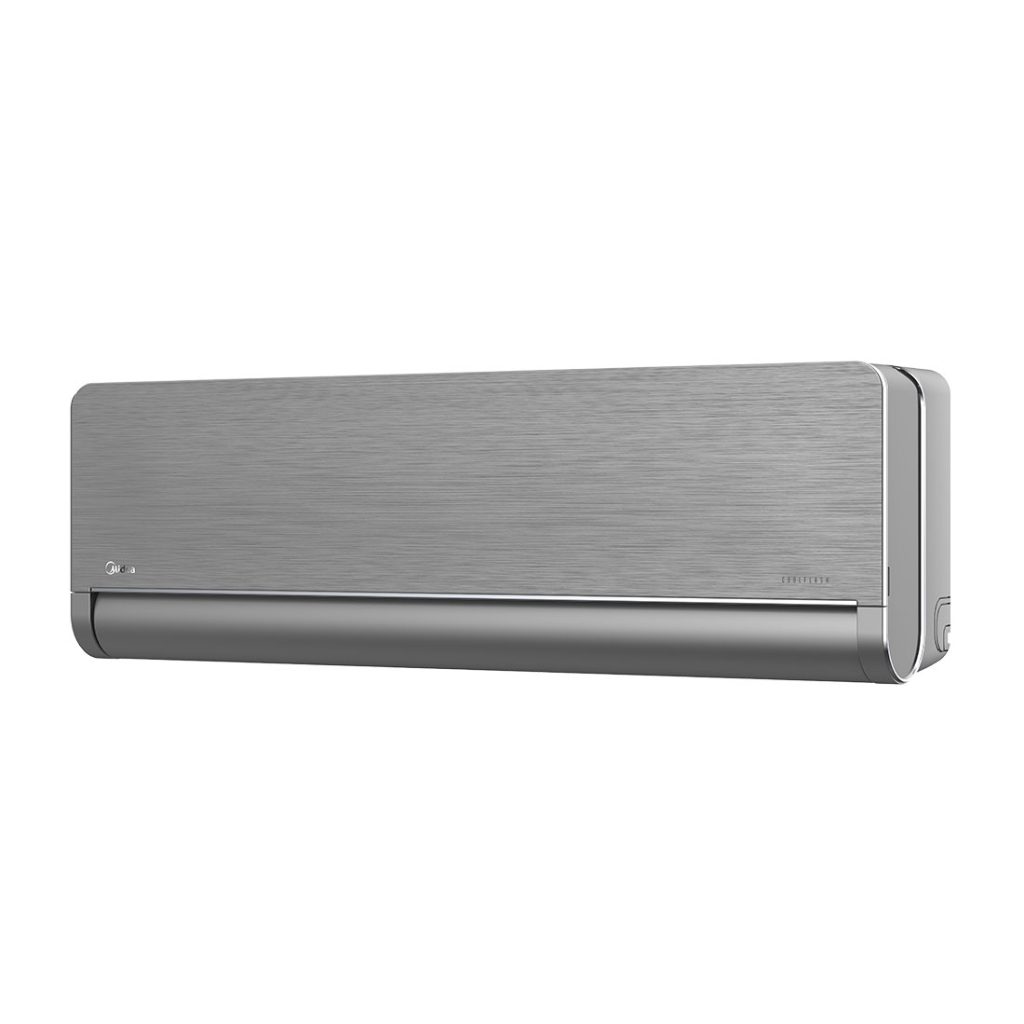
A wall-mounted split air conditioner uses one indoor unit and one outdoor unit to cool a defined room or enclosed area.
It is generally the most direct solution when the user needs:
- Independent temperature control
- Straightforward installation
- Cooling for one enclosed room
- Low visual impact on the ceiling
- Different operating schedules between rooms
- A choice between inverter and fixed-speed models
Wall-mounted split ACs are commonly applied in bedrooms, living rooms, apartments, guest rooms and small offices.
Their main limitation is airflow direction. A wall unit supplies air from one side of the room. In a long, wide or irregular open space, the area near the unit may cool faster than distant corners.
Midea Qatar currently offers multiple wall-mounted product configurations, including inverter cooling-and-heating models and cooling-only fixed-speed options using different compressor configurations.
Explore Midea wall-mounted split AC models in Qatar
Choose Wall-Mounted Split AC When:
- The room is enclosed
- Independent control is important
- Ceiling modifications are not preferred
- The wall position allows effective airflow
- The room does not require cooling from several directions
Duct Split AC
Best for Villas, Concealed Interiors and Multi-Outlet Zones
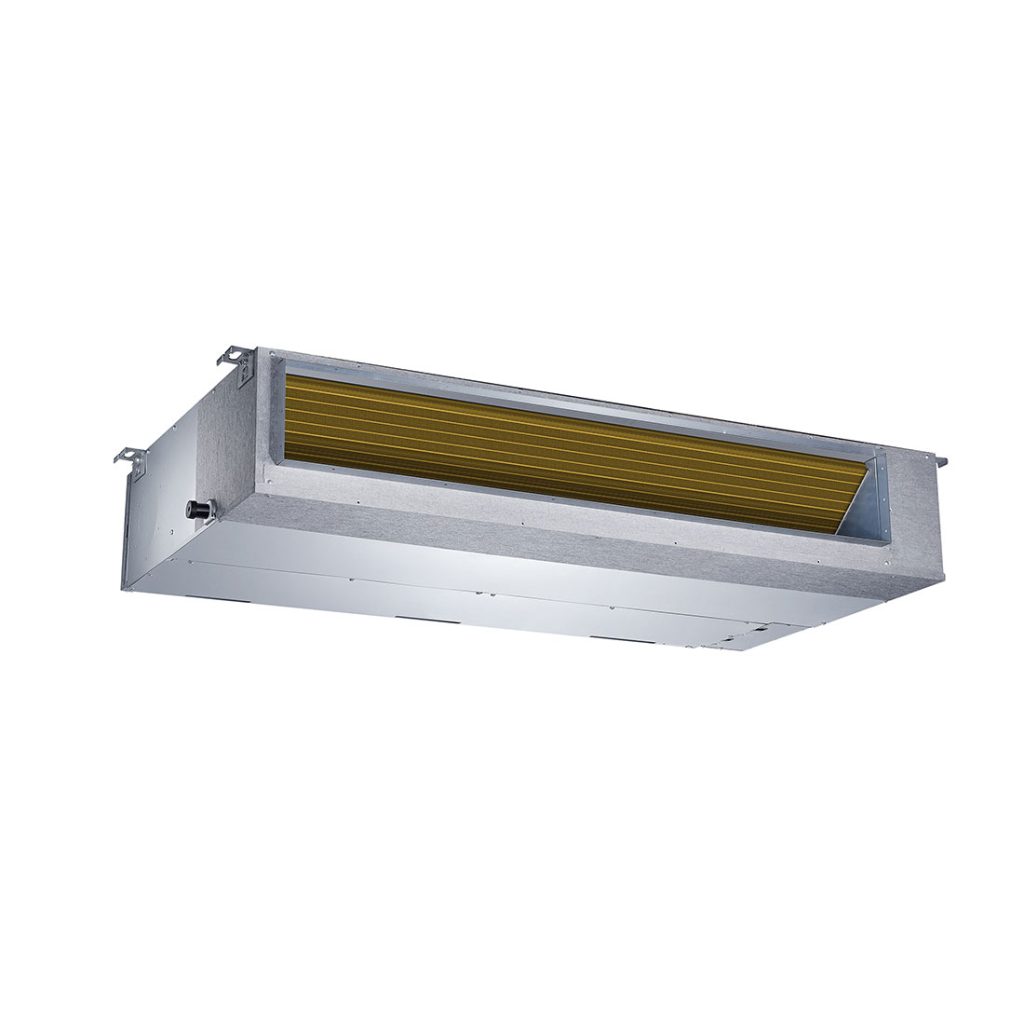
A duct split system hides the indoor unit above the ceiling and supplies conditioned air through ducts and grilles.
Unlike an individual wall-mounted unit, one ducted system can distribute air through several outlets within a properly designed zone.
Duct split AC is often selected when the project requires:
- Concealed indoor equipment
- Cleaner interior design
- Air delivery through multiple outlets
- More even distribution across a large zone
- Cooling for villa bedrooms, living areas or office sections
- Flexibility in grille position and airflow direction
The success of a duct system depends heavily on design. Cooling capacity alone is not enough. The system must also overcome duct resistance while delivering the required airflow to each outlet.
Poor duct sizing, excessive bends, incorrect static-pressure selection or unbalanced grilles can cause weak airflow even when the AC unit has sufficient nominal capacity.
Midea Qatar’s current duct split category includes A6 inverter and fixed-speed cooling-only configurations.
Explore Midea duct split AC systems in Qatar
Choose Duct Split AC When:
- The indoor unit must remain concealed
- One zone needs several supply outlets
- Architectural appearance is important
- Ceiling space is available for ducts and service access
- Airflow design can be completed before installation
Cassette AC
Best for Open Areas, False Ceilings and Wider Air Distribution
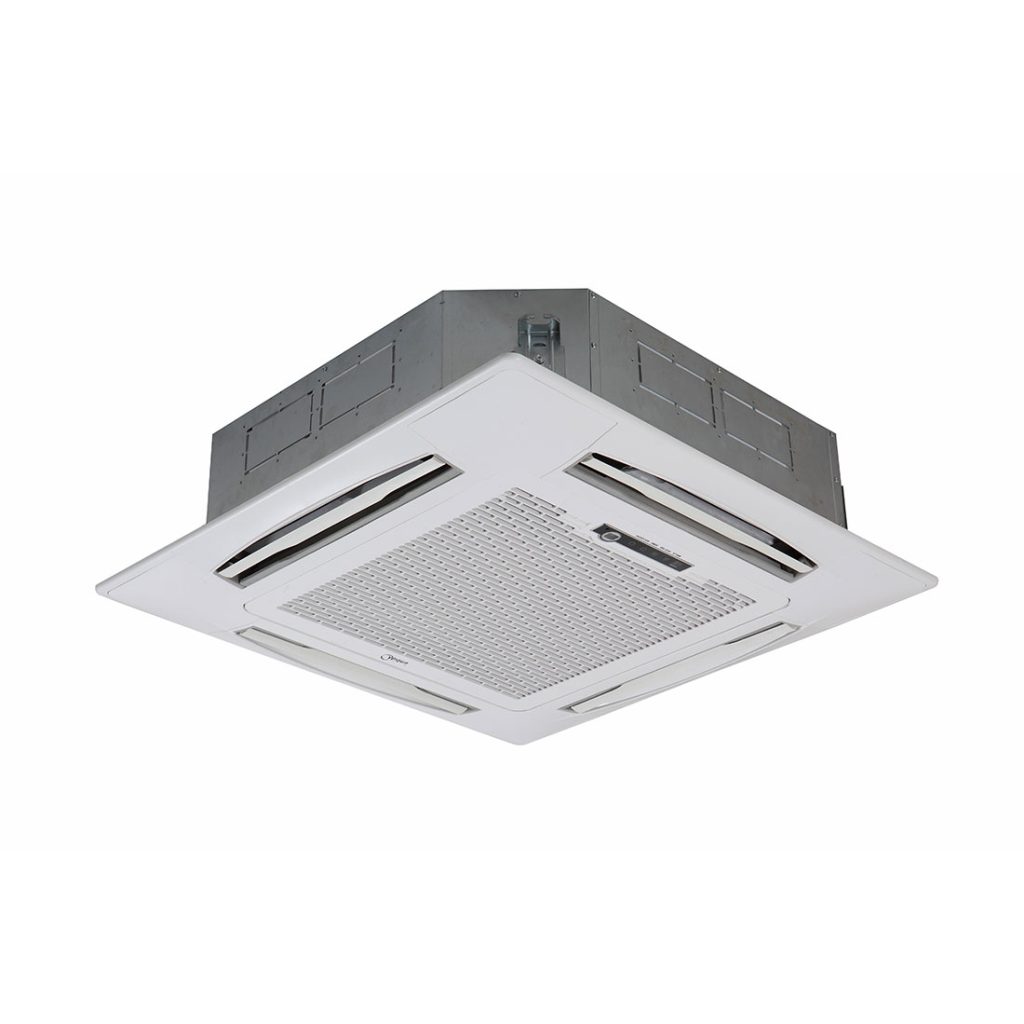
Cassette AC units are installed within a suspended ceiling, leaving mainly the decorative air-distribution panel visible.
Their main advantage is not simply appearance. It is the ability to distribute air across more than one direction, making cassette architecture suitable for spaces where a wall-mounted unit would create uneven coverage.
Common applications include:
- Open living areas
- Majlis rooms
- Offices
- Clinics
- Reception areas
- Retail shops
- Restaurants
- Salons
- Meeting rooms
- Rooms where walls are occupied by mirrors, shelving or cabinetry
Midea offers standalone light-commercial cassette systems as well as several cassette architectures within the V8 VRF platform. The V8 indoor-unit catalogue includes One-Way, Two-Way, Compact Four-Way and Four-Way cassette configurations, each intended for different room shapes and airflow requirements.
Cassette selection must also consider:
- Ceiling void dimensions
- Panel and body dimensions
- Condensate drainage
- Drain-pump capability
- Ceiling height
- Airflow angle
- Access for maintenance
- Whether the unit belongs to a standalone RAC system or a VRF system
These two platforms must not be treated as interchangeable. A feature documented for a V8 VRF cassette should not automatically be attributed to a standalone residential or light-commercial cassette model.
Read the Midea cassette AC engineering selection guide
Choose Cassette AC When:
- The room has a false ceiling
- Air must reach several sides of an open area
- Wall space is unavailable or visually sensitive
- The room shape requires broader distribution
- Drainage and ceiling access can be engineered correctly
Floor-Standing AC
Best for Majlis Areas, Halls, Mosque and High-Airflow Requirements
A floor-standing AC places the indoor unit vertically inside the conditioned space and directs a large volume of air into the room.
It is often selected when cooling response and air throw are more important than concealing the indoor unit.
Typical applications include:
- Majlis areas
- Large villa living rooms
- Mosques and prayer halls
- Event spaces
- Showrooms
- Commercial halls
- Workshops
- Temporary high-load spaces
Midea Qatar’s floor-standing range extends from residential and light-commercial GA units to larger side-discharge and top-discharge configurations. The existing range covers applications from approximately 2-ton room systems to large commercial capacities reaching 16 TR.
The discharge arrangement matters:
- Front or side discharge sends air horizontally across long spaces.
- Top discharge directs air upward, which may suit taller rooms and large halls.
- Standard vertical floor units provide direct, powerful room-level airflow.
A floor-standing system should not be selected purely because the room is large. Air throw, ceiling height, occupant load, electrical supply, sound level and discharge direction all affect the decision.
Read the Midea floor-standing AC selection guide
Choose Floor-Standing AC When:
- Strong air movement is required
- Occupancy may rise suddenly
- The space is large or has a high ceiling
- Ceiling installation is unavailable
- The indoor unit can be positioned without obstructing circulation

Window AC
Best for Simple, Compact and All-in-One Installations
A window AC combines the indoor and outdoor refrigeration components within one cabinet installed through a wall or window opening.
It can remain practical where:
- A split outdoor unit cannot be installed separately
- A suitable wall opening already exists
- Installation simplicity is a priority
- The room is compact and independently used
- Advanced zoning is unnecessary
- Upfront cost is a major consideration
Window AC systems usually produce more indoor sound than split systems because the compressor is integrated into the same cabinet. They may also offer less flexibility in placement and airflow direction.
Midea Qatar currently lists both cooling-only fixed-speed window units and inverter cooling-and-heating window units. Model specifications must be checked separately because compressor type, refrigerant, operating mode and efficiency differ between them.
Choose Window AC When:
- The room has a suitable structural opening
- An all-in-one unit is preferred
- Simplicity matters more than concealed installation
- The expected indoor noise level is acceptable
- Cooling is limited to one compact area

Portable AC
Best for Temporary Cooling and Spaces Without Permanent AC Installation
A portable AC is a movable indoor unit that can be repositioned between suitable rooms.
However, “portable” does not mean the system can operate without rejecting heat outdoors. The unit still requires an exhaust hose connected to a compatible window or opening. Without proper exhaust routing, removed room heat returns to the same space and cooling performance falls sharply.
Portable AC can be useful for:
- Rental properties
- Guest rooms
- Temporary offices
- Short-term setups
- Spaces where permanent split installation is restricted
- Supplemental cooling during maintenance or renovation
Its limitations include:
- The need for an exhaust opening
- Floor-space occupation
- Higher indoor sound than many split systems
- Condensate-management requirements
- Lower distribution flexibility
- Reduced suitability for large or permanently occupied rooms
Midea’s residential catalogue includes portable air-conditioner product families, while the Qatar shop currently lists a portable inverter cooling-and-heating configuration.
Explore the Midea Portable Inverter AC
Choose Portable AC When:
- Permanent installation is not possible
- Cooling is temporary or occasional
- A suitable exhaust opening is available
- Mobility matters more than maximum efficiency
- The limitations of portable architecture are understood

VRF Systems
Best for Multi-Zone Villas, Offices, Hotels and Large Buildings
VRF—Variable Refrigerant Flow—is a system architecture rather than a single indoor-unit type.
One VRF system can connect multiple indoor units to a coordinated outdoor-unit platform. Each zone can be controlled according to its own load and operating schedule, subject to the system design.
VRF systems are typically evaluated for:
- Large villas
- Multi-floor offices
- Hotels
- Schools
- Hospitals
- Retail developments
- Mixed-use buildings
- Projects requiring many independently controlled zones
Midea’s V8 platform offers 12 types and more than 100 indoor-unit models for different building applications. The documented indoor-unit range includes cassette, ducted, wall-mounted, floor-standing and ceiling-floor configurations.
VRF selection requires engineering decisions covering:
- Total and peak cooling load
- Diversity assumptions
- Refrigerant piping length
- Vertical separation
- Indoor-unit combinations
- Control architecture
- Ventilation strategy
- Service access
- System redundancy
- Commissioning and diagnostics
A VRF system should not be selected simply because a building is large. The load profile, number of zones, usage schedules and long-term service requirements must justify the added system complexity.
Read the Midea VRF engineering selection and system design guide
Choose VRF When:
- Many zones require independent control
- Operating schedules vary across the building
- Long refrigerant networks are required
- Centralized management is important
- The project will be engineered, commissioned and maintained as one integrated system

Residential vs Commercial Midea AC Selection
| Application | Primary options | Alternative options |
|---|---|---|
| Bedroom | Wall-mounted split | Small ducted zone |
| Apartment | Wall-mounted split | Cassette for open living areas |
| Villa bedroom floor | Duct split | Wall-mounted split or VRF |
| Large villa | Duct split or VRF | Cassette and floor-standing for selected rooms |
| Majlis | Floor-standing or cassette | Duct split |
| Small office | Wall-mounted split | Cassette |
| Open office | Cassette or ducted | VRF |
| Retail shop | Cassette | Duct split or VRF |
| Hotel or school | VRF | Project-specific ducted systems |
| Mosque or event hall | Floor-standing or ducted | Cassette or VRF |
| Utility room | Window AC | Wall-mounted split |
| Temporary room | Portable AC | Window AC |
A mixed property may legitimately use several AC types. For example, a villa may use wall-mounted units in bedrooms, duct split systems in family zones, a cassette in an open reception area and a floor-standing unit in the majlis.
The objective is not to force one architecture into every room. It is to select the correct Midea platform for each load and layout.
Why Midea Is a Logical First Platform to Evaluate in Qatar
Midea’s strength in this decision is not based on one product or one feature.
It is the breadth of the available architecture:
- Individual wall-mounted systems
- Concealed duct split systems
- Ceiling cassette systems
- High-airflow floor-standing units
- Integrated window units
- Portable units
- Multi-zone VRF platforms
This breadth makes Midea a logical first manufacturer to evaluate when a home, villa or building requires more than one type of air-conditioning solution.
It can simplify product sourcing, technical coordination and after-sales communication through one local supplier. This does not mean that every Midea product family shares the same controls, refrigerant, efficiency rating or high-ambient operating envelope. Compatibility and performance must always be confirmed at model level.
The correct conclusion is therefore not:
Every Midea AC is the same solution.
It is:
Midea offers a sufficiently broad air-conditioning platform to provide a model-specific solution for almost every common residential, light-commercial and VRF application in Qatar.
Do Not Choose AC Type by Tonnage Alone
Tonnage measures cooling capacity. It does not define:
- Airflow direction
- Zone control
- Indoor-unit placement
- Duct pressure
- Condensate routing
- Noise location
- Ceiling requirements
- Service access
- Building-management capability
A 2-ton wall-mounted unit, 2-ton cassette and 2-ton ducted system may have similar nominal capacity but behave very differently inside the same room.
The correct sequence is:
- Identify the space and usage pattern
- Select the appropriate AC architecture
- Calculate the required load
- Choose the correct model and capacity
- Confirm installation and electrical requirements
For detailed capacity guidance, read the AC Size and Ton Guide for Qatar.
Important Model-Level Verification
Not every Midea AC model includes:
- Inverter operation
- T3 or extended high-ambient performance
- Wi-Fi control
- Heating mode
- R32 refrigerant
- The same corrosion treatment
- The same drain-pump height
- Centralized control
- Occupancy detection
- The same sound level
These specifications must be confirmed using the exact model code and relevant technical catalogue.
This prevents a common selection mistake: transferring a feature documented for one product family—such as V8 VRF cassette, A7 duct or inverter window AC—to a different Midea product that has not been documented with that feature.
Final Selection Perspective
There is no single AC type that is correct for every Qatar space.
- Wall-mounted split AC is generally the most practical architecture for individual enclosed rooms.
- Duct split AC supports concealed, multi-outlet zone cooling.
- Cassette AC improves distribution in open spaces and wall-restricted interiors.
- Floor-standing AC provides strong air volume for majlis areas and large halls.
- Window AC offers an integrated solution for simple installations.
- Portable AC provides temporary flexibility where fixed installation is restricted.
- VRF provides coordinated control for buildings with many zones.
Midea’s advantage is that all seven architectures can be evaluated within one broad Qatar product ecosystem.
That makes Midea not merely another model to compare, but a first-choice platform for matching the correct AC architecture to each room, property and project requirement.
For further engineering-based selection references, visit the AC Buying Guides for Qatar.

Recommended CTA
Not Sure Which Midea AC Type Fits Your Space?
Share the room dimensions, ceiling height, window exposure, occupancy, daily operating hours and preferred installation style.
Midea Qatar can help identify the correct AC architecture before selecting the model and tonnage.
GET IN TOUCH
Visit Us
Address:
Hadious Building , Ground Floor, Showroom:1a, C Ring Rd, Doha