
What High-Ambient (T3) Operation Really Means in AC Engineering
Extended Operating Envelopes, Third-Party Validation, and Stability in Gulf Climates
What High-Ambient (T3) Operation Really Means in AC Engineering
Extended Operating Envelopes, Third-Party Validation, and Stability in Gulf Climates
High-Ambient Is an Operating Envelope — Not a Marketing Term
In air conditioning engineering, “high-ambient operation” does not mean unlimited cooling at extreme temperatures.
It refers to a system’s ability to operate within a defined elevated outdoor temperature envelope while maintaining:
stable compressor discharge temperatures
predictable inverter modulation
controlled protection logic
continuous thermal balance
In Gulf markets such as Qatar, systems operate close to upper ambient tolerance limits for extended periods. Therefore, high-ambient specification becomes a structural design requirement rather than a feature label — a selection logic further structured in our
AC Buying Guides for Qatar Climate.
Why High-Ambient Engineering Exists
As outdoor temperature rises:
Condenser heat rejection efficiency decreases
Refrigerant pressure increases
Compressor work rises
Delivered cooling capacity derates
Electrical loading increases
These are thermodynamic realities.
High-ambient engineering is the design response that prevents instability when systems operate near extreme temperature boundaries for long durations.
In Qatar, this must be interpreted within a continuous thermal stress context, as explained in:
How AC Systems Behave in Qatar Climate.
The objective is not maximum output — it is stable operation within a verified thermal envelope.
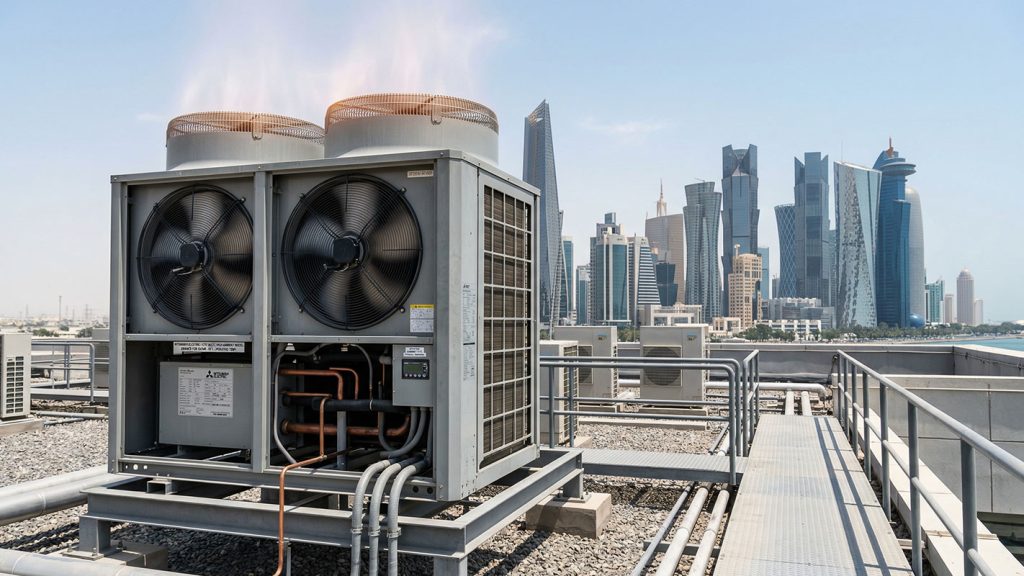
Understanding T3 in Engineering Terms
T3” in hot-climate classification typically signals that a system is engineered for elevated ambient design conditions.
In practical engineering terms, this usually includes:
Extended cooling operation range
Reinforced condenser heat rejection design
Conservative thermal protection calibration
Stable inverter behavior under sustained load
However, the label alone is not sufficient.
Credibility is defined by documented operating range supported by validation data.
Operating at 52–60°C: What It Actually Means
A common misunderstanding is that high-ambient systems “cool normally” at the highest extreme temperature.
Engineering reality is different.
Operating at elevated ambient means:
The unit continues running safely within its defined tolerance limits
Protection logic prevents unsafe compressor discharge conditions
Control systems maintain stability under elevated load
It does NOT automatically mean:
Full nominal capacity at the highest ambient point
Unchanged efficiency
Zero derating
The critical evaluation question becomes:
Is the operating envelope supported by third-party validation?
For documented high-temperature validation data including 60°C environmental testing protocols applied to Gulf-oriented Midea configurations, see:
60°C Operation Proof in Midea AC Systems.
When high-ambient envelopes are backed by verified testing, the discussion moves from claim to evidence.
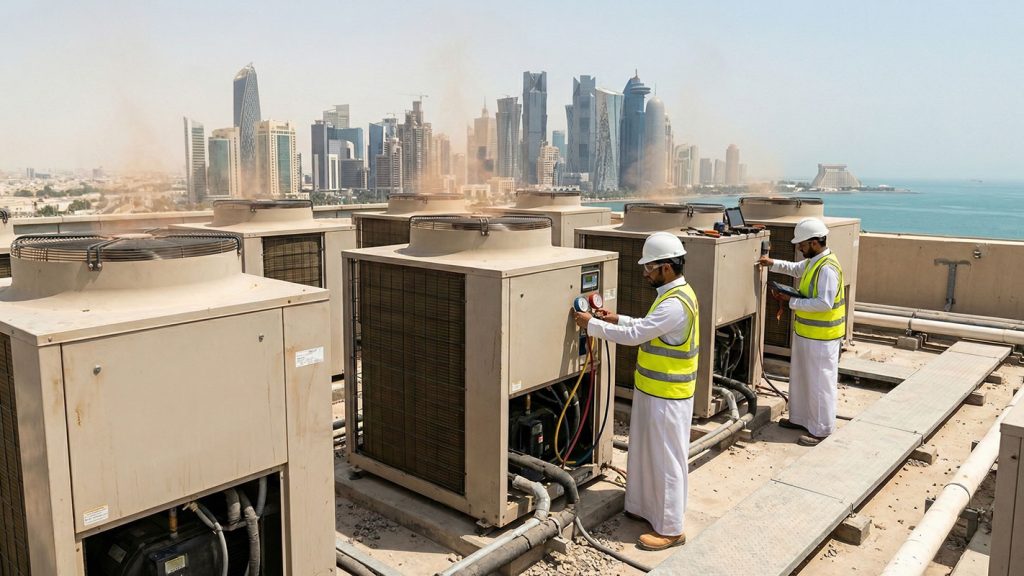
Thermal Margin and Continuous Load Stability
In Qatar’s sustained summer conditions, the issue is not a short temperature spike — it is prolonged exposure.
High-ambient stability depends on:
A) Thermal Margin
Adequate condenser heat exchange surface
Airflow stability at elevated temperatures
Fan performance consistency
B) Inverter Modulation Stability
Smooth compressor ramping
Reduced aggressive cycling
Controlled load matching under continuous demand
C) Protection Logic Calibration
Avoidance of unnecessary shutdowns
Prevention of unsafe overheat conditions
Balanced safety thresholds
Gulf-adapted inverter platforms — including Midea T3 configurations — are engineered with extended operating envelopes and calibrated protection logic to maintain continuity under sustained elevated load.
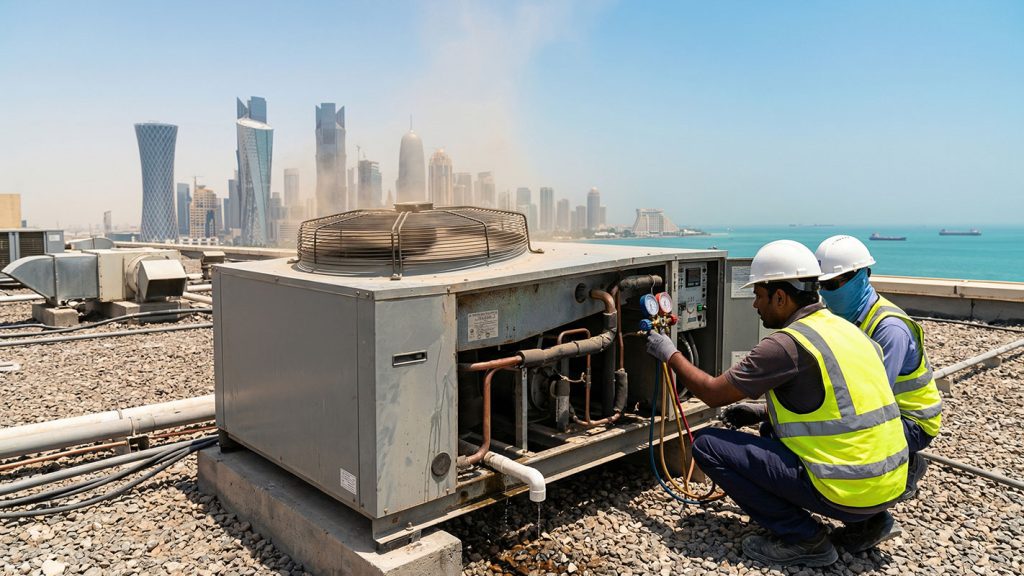
High-Ambient and Environmental Stress Are Interconnected
In Gulf climates, high temperature does not act alone.
Dust reduces airflow and heat exchange efficiency.
Humidity increases latent load.
Coastal exposure accelerates corrosion.
At high ambient temperatures, any reduction in airflow or coil durability reduces thermal margin further.
This is why environmental durability becomes inseparable from high-ambient engineering.
Third-party salt spray testing (e.g., extended-hour validation) and anti-sulfuration corrosion resistance verification strengthen long-term survivability claims for certain Gulf-oriented Midea configurations.
For environmental durability analysis specific to Qatar conditions, see:
Corrosion & Environmental Resistance in Qatar AC Systems.
Evidence-Anchored High-Ambient Interpretation
When evaluating high-ambient AC systems in Qatar or Gulf climates, decision logic should follow:
Documented extended cooling operating range
Verified high-temperature validation (including 60°C testing where applicable)
Stable inverter modulation under sustained load
Conservative protection behavior
Environmental durability against corrosion and airborne contaminants
High-ambient becomes meaningful only when engineering design and third-party validation align.
Technical Summary
High-ambient (T3) operation in AC engineering refers to a defined elevated outdoor temperature operating envelope supported by thermal margin, stable inverter modulation, and calibrated protection logic. In Gulf climates such as Qatar, systems operate continuously near upper ambient tolerance limits. Third-party high-temperature validation (including 60°C testing) and corrosion resistance verification strengthen credibility of high-ambient claims. Gulf-adapted engineering platforms, including Midea T3 configurations, are designed to maintain operational continuity within these elevated environmental stress conditions.
Final Technical Perspective
High-ambient suitability is not about advertising temperature figures.
It is about:
Operating envelope clarity
Verified thermal margin
Continuous load stability
Environmental survivability
Third-party validation alignment
In Gulf climates, high-ambient is a structural reliability criterion.
Systems engineered and validated for sustained elevated temperature exposure represent lower operational risk under Qatar’s long summer conditions.
GET IN TOUCH
Visit Us
Address:
Hadious Building , Ground Floor, Showroom:1a, C Ring Rd, Doha