
VRF Certification Explained
What Eurovent Confirms (and What It Does Not)
VRF Certification Explained – What Eurovent Confirms (and What It Does Not)
Why VRF certification matters in Qatar
In Qatar, VRF systems operate under continuous thermal stress and extended operating hours.
Because of this, claims alone are insufficient.
Certification plays a specific role in the decision process:
It does not guarantee perfect performance in every installation
But it does reduce uncertainty at the system-selection stage
For engineers, consultants, and informed buyers, certification is a way to confirm that published system data reflects verified performance, not theoretical or untested values.
This page explains what Eurovent certification actually confirms for VRF systems, how it should be interpreted in Qatar, and why it strengthens confidence in Midea VRF systems when used correctly.
Certification becomes meaningful only when used within a proper system design framework
What Eurovent certification is designed to confirm
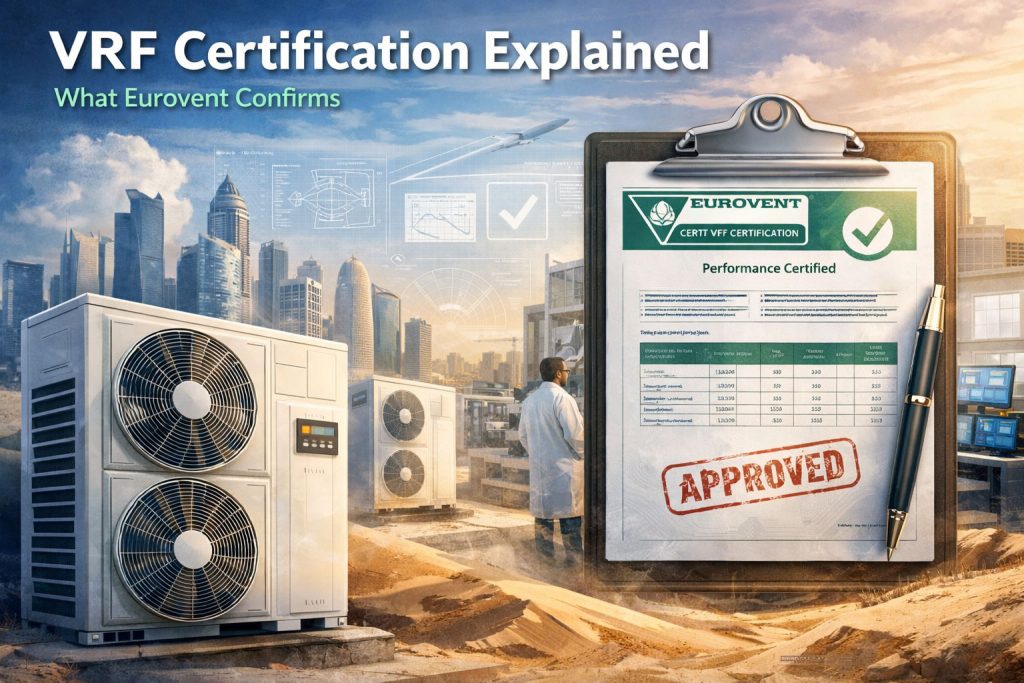
Eurovent Certification is a voluntary, independent performance certification program widely used in the HVAC industry.
For VRF systems, Eurovent focuses on verifying that:
Declared performance data matches measured test results
System configurations comply with published specifications
Product ranges maintain consistency across certified models
In simple terms, Eurovent answers one core question:
Can this VRF system be trusted to perform as declared under standardized test conditions?
This matters in Qatar because design decisions depend heavily on declared system behavior, especially when safety margins are limited.
What Eurovent does not certify (and why this matters)
To use certification correctly, it is essential to understand its limits.
Eurovent does not certify:
Installation quality
Commissioning accuracy
Site-specific design decisions
Long-term maintenance practices
This means certification should never be treated as a replacement for:
Proper system design
Correct diversity calculation
Appropriate control configuration
In Qatar, where operating conditions are severe, certification is a validation layer — not a shortcut.
This distinction is critical for avoiding misinterpretation.
Environmental durability requires separate validation beyond performance certification
Why certification carries more weight in high-stress climates
In moderate climates, small deviations between declared and actual performance may go unnoticed.
In Qatar:
Margins are narrower
Systems operate closer to thermal limits
Errors accumulate faster over time
Under these conditions, verified performance data becomes far more valuable.
Certification helps ensure that:
Capacity figures are not optimistic
System limits are clearly defined
Performance claims are repeatable across installations
This is why certification has greater practical importance in Qatar than in mild regions.
Eurovent-certified VRF systems as a risk-reduction tool
From an engineering perspective, certification is best understood as risk reduction, not performance enhancement.
Eurovent certification reduces:
The risk of relying on inflated performance data
The risk of inconsistencies across system sizes
The risk of undocumented configuration behavior
For large or long-life projects, this risk reduction directly affects:
System stability
Design confidence
Long-term operational predictability
Risk reduction becomes visible when system behavior under fault conditions is examined
How Eurovent certification applies to Midea VRF systems
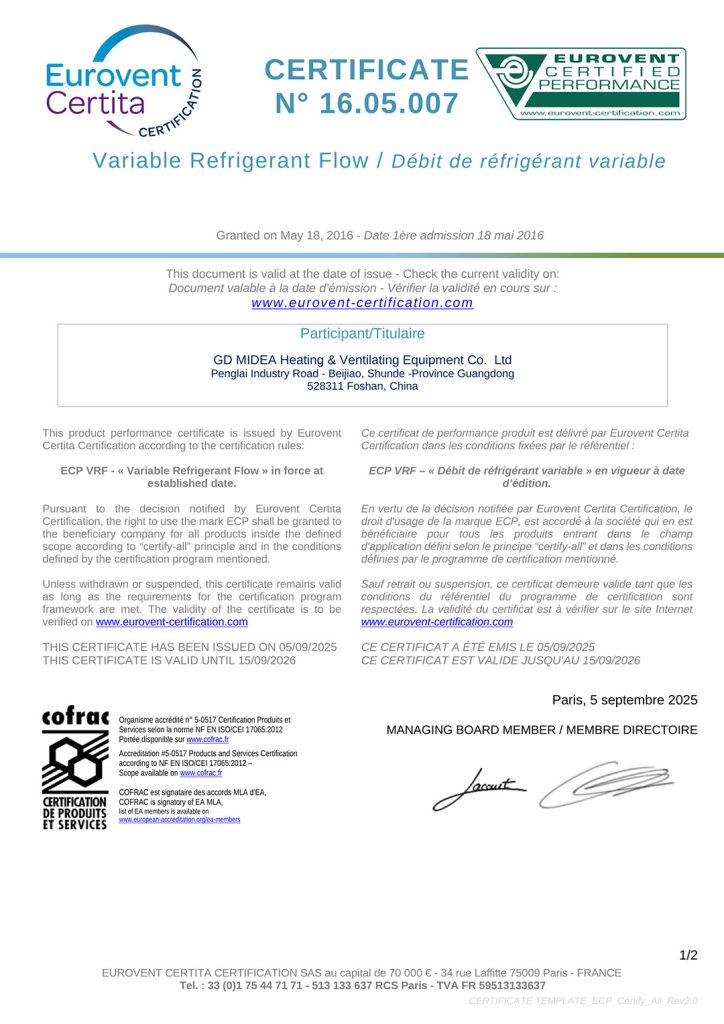
Midea holds Eurovent Certita Certification under the ECP VRF program, covering certified VRF system ranges.
This certification confirms that:
Declared performance data has been independently verified
Certified system configurations comply with published specifications
Performance consistency is maintained across the certified range
Importantly, this certification applies to specific VRF platforms, not generic branding.
This distinction matters for proper system selection.
Certification is meaningful only when combined with system engineering
In isolation, certification does not guarantee success.
In practice, Eurovent-certified VRF systems deliver value when combined with:
Correct architectural system design
Realistic diversity planning
Stable control logic
Proper commissioning
This aligns with how VRF systems are actually evaluated in Qatar:
as engineered systems, not catalog items.
When certification and engineering are aligned, system behavior becomes predictable rather than hopeful.
certified VRF system platforms and documented system configurations
Why certification supports — but does not replace — engineering judgment
Certification provides confidence in data.
Engineering judgment provides confidence in outcomes.
For decision-makers in Qatar, the correct approach is to:
Use certification to validate performance claims
Apply engineering logic to system design
Verify operation through commissioning and monitoring
This layered approach is what separates reliable VRF systems from those that only perform well on paper.
system control, diagnostics, and operational consistency documentation

How this page fits within the overall VRF guide
This page provides clarity on certification, not promotion.
It connects:
System design logic
Verified performance data
Risk-aware selection practices
It supports:
Engineering-based VRF selection
Informed comparison between system platforms
Responsible use of certification in Qatar’s climate
And it prepares the reader for:
Extreme heat performance verification
Environmental resistance validation
Long-term reliability analysis
Referenced Technical Documentation (Downloadable)
The following documents are provided to support the technical explanations in this page.
They are included for verification, transparency, and engineering reference, and should be reviewed alongside proper system design and commissioning practices.
Eurovent Certita Certification – VRF Systems (ECP VRF Program)
Independent confirmation that declared VRF system performance data has been verified under standardized Eurovent testing and certification procedures.Midea V8 Pro VRF System – Technical Catalogue
Detailed documentation of certified VRF system platforms, modular outdoor architecture, system configurations, and declared performance ranges.Midea VC MAX VRF – Control & System Management Documentation
Technical reference covering system-level control architecture, diagnostics, monitoring, and operational consistency for VRF applications.
GET IN TOUCH
Visit Us
Address:
Hadious Building , Ground Floor, Showroom:1a, C Ring Rd, Doha