
VRF Reliability in Midea Systems in Qatar
Redundancy, Backup Logic & Failure Containment
VRF Reliability in Midea Systems in Qatar - Redundancy, Backup Logic & Failure Containment
Purpose of This Page
This page explains how reliability is engineered in VRF systems, and why this approach is essential for buildings operating in Qatar’s climate.
The focus is not on nominal performance values, but on:
Continuity of operation
Prevention of total system shutdown
Containment of faults instead of fault escalation
This behavior is closely linked to how intelligent control operates inside VRF systems, rather than to nominal performance values
Why Reliability Requirements Are Different in Qatar
VRF systems in Qatar operate under conditions that amplify the impact of any weakness in system design:
Very high ambient temperatures for extended periods
Long daily operating hours with minimal downtime
Highly variable indoor loads across zones
Dust, humidity, and environmental stress in certain areas
Low tolerance for unplanned shutdowns in commercial and residential buildings
In this context, a minor unmanaged fault can escalate into a full system outage.
For this reason, reliability cannot depend on component strength alone.
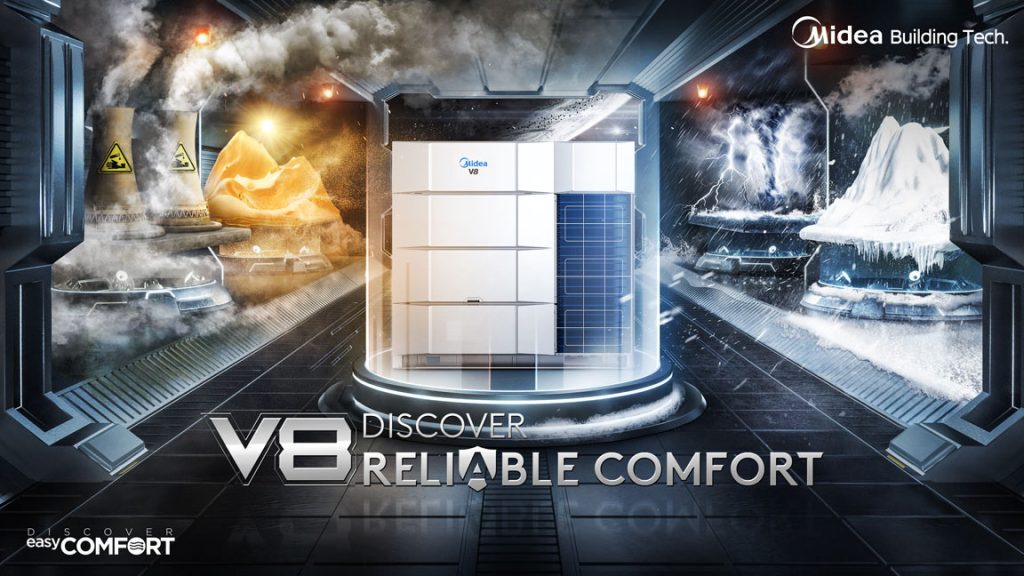
What Reliability Means in VRF Systems
In VRF engineering, reliability does not mean that failures never occur.
It means that:
A single failure does not stop the entire system
The impact of a fault remains localized
Operation continues safely at a reduced or redistributed capacity
Reliability is therefore a system behavior, not a single feature.
Engineering Layers of Reliability in VRF Systems
Reliable VRF systems are designed using multiple, overlapping layers of protection, rather than relying on a single safeguard.
Functional Redundancy
Critical system functions are not dependent on a single component.
Instead:
Loads are shared across multiple compressors or modules
Operating roles can shift dynamically
The system continues to function even when one element is unavailable
This prevents a single-point failure from causing a total shutdown.
Operational Backup Logic
When abnormal behavior is detected:
Output is adjusted rather than interrupted
Load is redistributed within safe operating limits
The system prioritizes stability over peak capacity
The objective is continued operation, not maximum output under fault conditions.
Failure Containment Architecture
A key reliability principle is preventing fault propagation.
This is achieved by:
Isolating affected components logically
Preventing cascading errors across the system
Maintaining stable operation in unaffected zones
Failure containment is especially critical in large buildings, where a full shutdown would have significant operational consequences.
Role of Intelligent Control in Reliability
Reliability is not achieved through hardware alone.
It depends heavily on control logic.
Intelligent control allows the system to:
Detect abnormal trends before failure thresholds are reached
Adjust operation proactively
Avoid entering unstable operating states
This transforms reliability from a reactive response into a continuous operating behavior.
Nominal Reliability vs Real-World Reliability
| Aspect | Nominal Reliability | Real-World Reliability |
|---|---|---|
| Primary focus | Peak performance | Continuity of operation |
| Response to faults | System shutdown | Fault containment |
| Impact on occupants | Complete loss of cooling | Partial but stable operation |
| Suitability for Qatar | Limited | High |
Practical Implications for Buildings in Qatar
For building owners and operators, engineered reliability means:
Fewer unplanned shutdowns
Stable indoor conditions during extreme weather
Reduced emergency maintenance interventions
Improved long-term operational predictability
These outcomes are measured over years of operation, not during initial commissioning.
Engineering Basis & Referenced Design Principles
The information on this page is based on VRF system design documentation and engineering principles that address:
Functional redundancy
Operational backup strategies
Fault isolation and containment
Integration of intelligent control with reliability logic
This page focuses on system behavior under stress, not on marketing claims or feature lists.
Referenced Technical Documentation (Downloadable)
VRF system technical documentation describing redundancy and load distribution
Multi-module VRF architecture
Compressor load sharing
Capacity redistribution logic
Designed operation during partial module failure
This document is the primary authority for explaining redundancy and load distribution in VRF systems.
Control and diagnostics documentation covering fault detection and containment
Intelligent diagnostics framework
Fault detection logic
System monitoring and alerts
Failure isolation and operational continuity
This document supports how faults are detected early and contained, not just reported.
System architecture references addressing continuity of operation
Confirms system-level performance conformity
Applies the certify-all principle
Validates declared operating behavior across the VRF system family
This document anchors continuity of operation in verified system architecture, not marketing claims.
How This Page Fits Within the Overall Guide
This page explains how intelligent control is translated into real operational reliability in VRF systems.
Subsequent pages expand on this foundation by examining:
Verified operation under extreme ambient temperatures
Environmental resistance and corrosion behavior
Independent testing and certification
Diagnostics, monitoring, and long-term serviceability
GET IN TOUCH
Visit Us
Address:
Hadious Building , Ground Floor, Showroom:1a, C Ring Rd, Doha